Geography
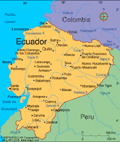
Ecuador, about equal in area to Nevada, is in the northwest part of South America fronting on the Pacific. To the north is Colombia and to the east and south is Peru. Two high and parallel ranges of the Andes, traversing the country from north to south, are topped by tall volcanic peaks. The highest is Chimborazo at 20,577 ft (6,272 m). The Galápagos Islands (or Colón Archipelago: 3,029 sq mi; 7,845 sq km), in the Pacific Ocean about 600 mi (966 km) west of the South American mainland, became part of Ecuador in 1832.
Government
Republic.
History
The tribes in the northern highlands of Ecuador formed the Kingdom of Quito around 1000. It was absorbed, by conquest and marriage, into the Inca Empire. Spanish conquistador Francisco Pizarro conquered the land in 1532, and throughout the 17th century a Spanish colony thrived by exploitation of the Indians. The first revolt against Spain occurred in 1809. In 1819, Ecuador joined Venezuela, Colombia, and Panama in a confederacy known as Greater Colombia.
When Greater Colombia collapsed in 1830, Ecuador became independent. Revolts and dictatorships followed; it had 48 presidents during the first 131 years of the republic. Conservatives ruled until the revolution of 1895 ushered in nearly a half century of Radical Liberal rule, during which the church was disestablished and freedom of worship, speech, and press was introduced. Although it was under military rule in the 1970s, the country did not experience the violence and repression characteristic of other Latin American military regimes. Its last 30 years of democracy, however, have been largely ineffectual because of a weak executive branch and a strong, fractious Congress.
Peru invaded Ecuador in 1941 and seized a large tract of Ecuadoran territory in the disputed Amazon region. In 1981 and 1995 war broke out again. In May 1999, Ecuador and Peru signed a treaty ending the nearly 60-year border dispute.
The Arrival of El Nino Ushers in a Period of Economic Instability
In 1998, Ecuador experienced one of its worst economic crises. El Niño caused $3 billion in damage; the price of its principal export, oil, plunged; and its inflation rate—43%—was the highest in Latin America. In 1999, the government was near bankruptcy, the currency lost 40% of its value against the dollar, and the poverty rate soared to 70%, doubling in five years. The president's economic austerity plan was protested with massive strikes in March 1999.
President Jamil Mahuad was overthrown in Jan. 2000, in the first military coup in Latin America in a decade. The junta gave power to the vice president, Gustavo Noboa. Faced with the worst economic crisis in Ecuador's history, Noboa restructured Ecuador's foreign debt, adopted the U.S. dollar as the national currency, and continued privatization of state-owned industries, generating enormous opposition. In Feb. 2001, the government cut fuel prices after violent protests by Indians, who are among Ecuador's most disadvantaged people. Within two years, Ecuador's economy had rebounded from the brink of collapse. The economy grew by 5.4% for 2001, the highest rate in Latin America. Inflation was 22%, down from 91% in 2000, and the budget was balanced. But chronic corruption among senior government officials, as well as among the courts and the judiciary, has continued.
Lucio Gutiérrez, a leftist colonel best known for orchestrating the 2000 coup against President Jamil Mahuad, was elected to the presidency in 2003 on an anticorruption platform. He became Ecuador's sixth president in seven years. His attempts to introduce austere fiscal reforms, however, quickly alienated his political base, and numerous national strikes took place throughout 2003. In April 2005, Gutiérrez was ousted by the Ecuadoran Congress, after replacing much of the supreme court with his allies. Polls at the time indicated that just 5% of the people supported him. His estranged deputy, Alfredo Palacio, took over as president. In 2006, huge nationwide protests took place concerning a potential free-trade agreement with the U.S. In the Nov. 2006 presidential runoff elections, Rafael Correa, a left-wing economist, won with 56.7% of the vote, defeating conservative businessman Alvaro Noboa. Correa took office in Jan. 2007.
President Rafael Correa Wins New Constitution and Seeks to Establish Internal Stability
Correa immediately set out to boost economic growth and root out corruption in the country's political system. In an April 2007 referendum, voters overwhelmingly approved his call to rewrite the constitution. He hoped the new constitution would weaken Congress, which has been called inept and corrupt. Correa's critics accused him of trying to consolidate power, with moves reminiscent of Venezuelan president Hugo Chavez. In September 2008, 64% of voters approved the new constitution that increased presidential powers and allowed Correa to run for two more consecutive terms.
In March 2008, Colombian forces crossed into Ecuadorean territory and killed FARC rebel leader Raúl Reyes and 20 other rebels. In response, Venezuela and Ecuador broke off diplomatic relations with Colombia and sent troops to the Colombian borders, although both countries denied any ties to FARC. In an attempt to help cool the diplomatic tension between the three countries, the Organization of American States approved a resolution, which declared that the Colombian raid into Ecuador was a violation of sovereignty. On March 6, Nicaragua broke off diplomatic relations with Colombia to demonstrate unity with President Rafael Correa of Ecuador. On March 7, 2008, during a summit meeting in the Dominican Republic, the leaders of Colombia, Ecuador, Venezuela, and Nicaragua ended their diplomatic dispute over Colombia's raid into Ecuador.
In September 2010, police protesting Correa's plan to end bonuses and reduce other benefits for the force fired tear gas at the president and then held him captive in a hospital for more than 12 hours. He was rescued by special forces, but five people were killed in the operation and nearly 40 were injured. Correa accused the officers of attempting a coup and declared a state of emergency.
A package of ten constitutional amendments tackling judicial and media reforms went to vote on May 7, 2011. President Rafael Correa's "Yes" campaign won all the questions with an average just over 47%. Correa claimed the referendums were needed to support the police and eliminate corrupt and inept judges; opponents say the reforms were a presidential power-seeking move.
Correa Pardons Four in Libel Case
In late February 2012, President Correa pardoned three newspaper executives and one columnist in a libel case. The pardon wiped out a three year prison sentence and $42 million in fines for the men and El Universo, the country's leading opposition newspaper. Correa said in a statement after the pardon, "The abusive press has been defeated." The pardon came months after Correa sued El Universo. The lawsuit was over a columnist accusing him of ordering troops to fire on a hospital during an uprising in September 2011. Correa denied giving the order. The courts ruled in his favor.
Correa, who has battled the media since he took office, maintains that he is fighting a media that favors businesses and people who own the media companies. Meanwhile human-rights groups say that Correa uses his position to silence criticism of his government.
Ecuador Grants Asylum to Julian Assange
On August 16, 2012, Ecuador announced that it was granting political asylum to WikiLeaks founder Julian Assange. Assange had been seeking refuge at the country's Embassy in London while waiting for the decision. The decision further strained relations between Ecuador and Britain. The night before the announcement, Foreign Minister Ricardo Patiño reported that British officials had threatened to invade Ecuador's embassy. In response to the threat, Patiño said, "We are not a British colony." On the morning of the asylum announcement, President Correa tweeted this message on his personal Twitter account: "No one is going to terrorize us!"
Patiño announced the asylum at a news conference, where he said, "The government of Ecuador, faithful to its tradition of protecting those who seek refuge in its territory or in its diplomatic missions, has decided to grant diplomatic asylum to Julian Assange." Patiño added that Assange could face the death penalty if tried in the United States. Britain continued to reject the request for Assange to be moved to Ecuador from the embassy in London. Britain maintained its legal obligation to extradite Assange to Sweden. In Sweden, Assange was still wanted for questioning over accusations of sexual assault.
President Correa Begins His Third Term
On May 24, 2013, President Rafael Correa began his third term. Correa's third term started with his popularity extremely high and with more than a two-thirds majority in Congress. Correa also had a stable economy to work with as well as a weak and divided opposition.
Correa was re-elected in February 2013, when he received three times more votes than his closest competitor. According to Ecuador's current constitution, he would not be able to run for another term.
See also Encyclopedia: Ecuador .
National Institute of Statistics and Census (INEC) (In Spanish only) www.inec.gov.ec/ .
U.S. State Dept. Country Notes: Ecuador