Bangladesh | Facts & Information

- Bangladesh Profile
Infoplease has everything you need to know about Bangladesh. Check out our country profile, full of essential information about Bangladesh's geography, history, government, economy, population, culture, religion and languages. If that's not enough, click over to our collection of world maps and flags.
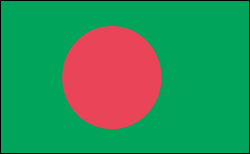
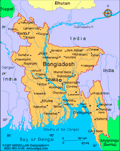
Facts & Figures
-
President: Abdul Hamid (2013)
Prime Minister: Sheikh Hasina (2009)
Land area: 50,258 sq mi (130,170 sq km); total area: 57,320 sq mi (148,460 sq km)
<
Population (2022 est.):165,650,475 (growth rate: .93%); birth rate: 17.69/1000; infant mortality rate: 30.35/1000; life expectancy: 74.7
Capital and largest city (2022 est.): Dhaka, 22.478 million
Other large cities: Chittagong, 5.253 million; Khulna, 950,000; Rajshahi 942,000; Sylhet, 928,000; Bogra, 864,000
Monetary unit: Taka
Principal languages: Bangla 98.8% (official, also known as Bengali), other 1.2% (2011 est.)
Ethnicity/race: Bengali at least 98%, other indigenous ethnic groups 1.1% (2011 est.)
Religions: Muslim 88.4%, other 11.6% (2020 est.)
National Holiday: Independence Day, March 26
Literacy rate: 74.9% (2020 est.)
Economic summary: GDP/PPP (2020 est.): $793.49 billion; per capita $4,800. Real growth rate:7.4%. Inflation: 5.5%. Unemployment: 4.4% (includes underemployment). ;Arable land: 59%. Agriculture: ice, jute, tea, wheat, sugarcane, potatoes, tobacco, pulses, oilseeds, spices, fruit; beef, milk, poultry. Labor force: 66.64 million; note: extensive export of labor to Saudi Arabia, Kuwait, UAE, Oman, Qatar, and Malaysia; agriculture 42.7%, industry 20.5%, services 36.9% (2016). Industries: cotton textiles, jute, garments, tea processing, paper newsprint, cement, chemical fertilizer, light engineering, sugar. Natural resources: natural gas, arable land, timber, coal. Exports: $38.78 billion (2020 est.): garments, jute and jute goods, leather, frozen fish and seafood. Imports: $57.26 billion (2020 est.): machinery and equipment, chemicals, iron and steel, textiles, foodstuffs, petroleum products, cement.Major trading partners: U.S., Germany, UK, France, Italy, India, China, Kuwait, Japan, Spain, Canada, Malaysia, Republic of Korea (2020).
Member of Commonwealth of Nations
Communications: Telephones: main lines in use: 1,390,048 (2020); mobile cellular: 176,279,465 (2020). Broadcast media: The government also owns a medium wave radio channel and some private FM radio broadcast news channels. Of the 41 Bangladesh approved TV stations, 26 are currently being used to broadcast. Of those, 23 operate under private management via cable distribution. Collectively, TV channels can reach more than 50 million people across the country (2020). Internet hosts: 10,052,819 (2020). Internet users: 41,172,346 (2020).
Transportation: Railways: total: 2,460 km Highways: total: 369,105 km; paved: 110,311 km; unpaved: 258,794 km (2018). Waterways: 8,370 km (2011) (includes up to 3,060 km of main cargo routes; network reduced to 5,200 km in the dry season). Ports and harbors: Chittagong, Mongla Port. Airports: 18 (2021).
International disputes: Bangladesh referred its maritime boundary claims with Burma and India to the International Tribunal on the Law of the Sea; Indian Prime Minister Singh's September 2011 visit to Bangladesh resulted in the signing of a Protocol to the 1974 Land Boundary Agreement between India and Bangladesh, which had called for the settlement of longstanding boundary disputes over undemarcated areas and the exchange of territorial enclaves, but which had never been implemented; Bangladesh struggles to accommodate 29,000 Rohingya, Burmese Muslim minority from Arakan State, living as refugees in Cox's Bazar; Burmese border authorities are constructing a 200 km (124 mi) wire fence designed to deter illegal cross-border transit and tensions from the military build-up along border.
Trending
Here are the facts and trivia that people are buzzing about.