Geography
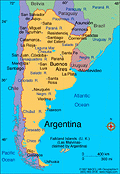
Second in South America only to Brazil in size and population, Argentina is a plain, rising from the Atlantic to the Chilean border and the towering Andes peaks. Aconcagua (22,834 ft, 6,960 m) is the highest peak in the world outside Asia. Argentina is also bordered by Bolivia and Paraguay on the north, and by Uruguay and Brazil on the east. The northern area is the swampy and partly wooded Gran Chaco, bordering Bolivia and Paraguay. South of that are the rolling, fertile Pampas, which are rich in agriculture and sheep- and cattle-grazing and support most of the population. Further south is Patagonia, a region of cool, arid steppes with some wooded and fertile sections.
Government
Republic.
History
First explored in 1516 by Juan Diaz de Solis, Argentina developed slowly under Spanish colonial rule. Buenos Aires was settled in 1580; the cattle industry was thriving as early as 1600. Invading British forces were expelled in 1806—1807, and after Napoleon conquered Spain (1808), the Argentinians set up their own government in 1810. On July 9, 1816, independence was formally declared.
As it had in World War I, Argentina proclaimed neutrality at the outbreak of World War II, but in the closing phase declared war on the Axis powers on March 27, 1945. Juan D. Peron, an army colonel, emerged as the strongman of the postwar era, winning the presidential elections of 1946 and 1951. Peron's political strength was reinforced by his second wife—Eva Duarte de Peron (Evita)—and her popularity with the working classes. Although she never held a government post, Evita acted as de facto minister of health and labor, establishing a national charitable organization, and awarding generous wage increases to the unions, who responded with political support for Peron. Opposition to Peron's increasing authoritarianism led to a coup by the armed forces, which sent Peron into exile in 1955, three years after Evita's death. Argentina entered a long period of military dictatorships with brief intervals of constitutional government.
The former dictator returned to power in 1973 and his third wife, Isabel Martinez de Peron, was elected vice president. After her husband's death in 1974, Peron became the hemisphere's first woman chief of state, assuming control of a nation teetering on economic and political collapse. In 1975, terrorist acts by left- and right-wing groups killed some 700 people. The cost of living rose 355%, and strikes and demonstrations were constant. On March 24, 1976, a military junta led by army commander Lt. Gen. Jorge Rafael Videla seized power and imposed martial law.
The Dirty War Begins
The military began the "dirty war" to restore order and eradicate its opponents. The Argentine Commission for Human Rights, in Geneva, has charged the junta with 2,300 political murders, over 10,000 political arrests, and the disappearance of 20,000 to 30,000 people. The economy remained in chaos. In March 1981, Videla was deposed by Field Marshal Roberto Viola, who in turn was succeeded by Lt. Gen. Leopoldo Galtieri.
On April 2, 1982, Galtieri invaded the British-held Falkland Islands, known as Las Islas Malvinas in Spanish, in what was seen as an attempt to increase his popularity. Great Britain, however, won a decisive victory, and Galtieri resigned in disgrace three days after Argentina's surrender. Maj. Gen. Reynaldo Bignone took over June 14, amid increasing pro-democratic public sentiment. As the 1983 elections approached, inflation hit 900% and Argentina's crippling foreign debt reached unprecedented levels.
In the presidential election of Oct. 1983, Raul Alfonsin, leader of the Radical Civic Union, handed the Peronist Party its first defeat since its founding. Growing unemployment and quadruple-digit inflation, however, led to a Peronist victory in the elections of May 1989. Alfonsin resigned a month later in the wake of riots over high food prices, in favor of the new Peronist president, Carlos Menem. In 1991, Menem promoted economic austerity measures that deregulated businesses and privatized state-owned industries. But beginning in Sept. 1998, eight years into Menem's two-term presidency, Argentina entered its worst recession in a decade. Menem's economic policies, tolerance of corruption, and pardoning of military leaders involved in the dirty war eventually lost him the support of the poor and the working class who had elected him.
Recession and Economic Instability
In Dec. 1999, Fernando de la Rua became president. Despite the introduction of several tough economic austerity plans, by 2001 the recession had slid into its third year. The IMF gave Argentina $13.7 billion in emergency aid in Jan. 2001 and $8 billion in Aug. 2001. The international help was not enough, however, and by the end of 2001, Argentina was on the verge of economic collapse. Rioters protesting government austerity measures forced De la Rua to resign in Dec. 2001. Argentina then defaulted on its $155 billion foreign debt payments, the largest such default in history.
After more instability, Congress named Eduardo Duhalde president on Jan. 1, 2002. Duhalde soon announced an economic plan devaluing the Argentine peso, which had been pegged to the dollar for a decade. The devaluation plunged the banking industry into crisis and wiped out much of the savings of the middle class, plunging millions of Argentinians into poverty.
Economy on the Rebound
Peronist Néstor Kirchner, the former governor of Santa Cruz, became Argentina's president in May 2003, after former president Carlos Menem abandoned the race. Kirchner vowed to aggressively reform the courts, police, and armed services and to prosecute perpetrators of the dirty war. Argentina's economy has been rebounding since its near collapse in 2001, with an impressive growth rate of about 8% since Kirchner took office. In March 2005, Kirchner announced that the country's debt had been successfully restructured. In Jan. 2006, Argentina paid off its remaining multi-million IMF debt early, a dramatic move that not all economists thought was beneficial.
In October 2007, First Lady Cristina Fernández de Kirchner was elected president, taking 45% of the vote. Elisa Carrió, a congresswoman, placed second, with 23%.
On December 10, 2007, Cristina Fernández de Kirchner took over the presidency from her husband, Néstor Kirchner, in a ceremony at Argentina's Congress. She kept many of her husband's ministers, but implied that she would introduce changes to the country during presidency. Fernandez said she will create a new ministry for science and technology to boost innovation, and stated that she would make "necessary corrections" to help the inflation problem in Argentina. Although she is as much a nationalist as her husband and refuses to get involved with the IMF, Fernández has shown interest in forging closer ties with the United States, Europe, and Brazil.
President and Vice President At Odds on Big Issues
Farmers protesting tax increases on export goods went on strike in early 2008, causing highways to be shut down and severe food shortages nationwide. In July, after months of protests and strikes by the farmers, the government, led by Vice President Cobos, sided with the farmers and voted against the president's proposed increase on the agricultural export tax.
In November 2008, the lower house of Parliament approved President Fernandez's controversial plan to nationalize more than $25 billion in private pension funds. President Fernandez asserted the move would protect pensioners' assets during the global financial crisis, while Vice President Cobos continued to disagree, stating it would create doubts among investors about Argentina's investment market stability.
The dispute over the Falkland Islands between Argentina and the UK resurfaced in February 2010 when a British oil rig began drilling near the islands. Both countries still claim sovereignty over the Falklands, and Argentina was outraged that it may have to confront the embarrassing fact that England could tap vast deposits of oil so close to its shores. Argentina responded by threatening to implement new restrictions on British ships passing through its waters.
In July 2010, Argentina became the first country in Latin America to legalize gay marriage.
Former president Nestor Kirchner and the husband of current president, Cristina Fernandez, died suddenly of a heart attack in October. He had been expected to run for president in 2011.
In February 2011, Argentine customs seized undeclared equipment on a United States Air Force cargo plane. The plane was carrying materials for an Argentina federal police training course. Customs officials described the seized equipment as machine guns, ammo, drugs such as morphine, and spy equipment. Argentina accused the United States military of bringing in guns and surveillance equipment under the guise of a training course. The incident created a diplomatic rift between the two countries.
In June 2011, President Fernandez announced that she was running for re-election. Polls showed that even though President Fernandez lacks majority support, she might easily win the first-round vote on Oct. 23 because the opposition is so divided.
President Cristina Fernández de Kirchner Easily Wins Second Term
On October 23, 2011, President Cristina Fernández de Kirchner was easily re-elected for a second term. Her victory came just two years after her approval rating fell below 30 percent due to her unpopular combative leadership style, which came under scrutiny during a dispute over agricultural export taxes. However, Argentina is currently undergoing an economic boom despite economists' predictions that the plan put into place by Fernández's late husband, former President Néstor Kirchner, was doomed.
That economic plan, which relies heavily on government subsidies, has been further orchestrated by President Fernández. Argentina's economy is expected to grow 8 percent in 2011, making it the fastest growing country in Latin America. Since 2007, the poverty rate has been cut by more than half. The employment rate has reached record highs and the country's agricultural products are in strong demand from China.
In this election, voters looked past red flags such as rising inflation. In 2010, inflation rose over 20 percent, second only to Venezuela in Latin America. Clearly what mattered most to voters was a booming economy. President Fernández won with 54 percent of the vote. Her closest opponent received 17 percent. With a margin of 37 percent, it was the widest victory since Argentina restored its democracy in 1983.
In December 2011, a spokesman for President Fernández announced that she had thyroid cancer and would undergo surgery on January 4. During a televised address the spokesman said there was "no existence of metastasis." The announcement came less than two months after Fernández was re-elected to a new four-year term. In 2010, Argentina was shocked when Fernández's husband, the country's previous president, died of a heart attack at age 60. The news of Fernández's diagnosis also shook up a country that has long revered Eva "Evita" Peron, wife of legendary leader Juan Peron. Peron died of cancer in 1952 at age 33. Like Eva Peron, Fernández is popular for her efforts to help the impoverished.
President Fernández was one of several leaders in the region recently diagnosed with cancer. President Dilma Rousseff of Brazil was treated for lymphoma in 2009. In 2010, Paraguay's president, Fernando Lugo, was treated for non-Hodgkins lymphoma. Venezuela's Hugo Chávez underwent treatment for an undisclosed type of cancer in 2011. In early January 2012, President Fernández's surgery was carried out without complications, putting her on course to return to work as planned later in the month.
Historic Rulings on Abortion, Transgender Rights
In March 2012, the Supreme Court unanimously ruled that rape victims can get an abortion. The ruling was historic because most abortions are illegal in Argentina. Before the ruling, a judge had to decide, case by case, which victims could get abortions. Typically, a judge ruled for the abortion only if the woman had mental disabilities. The new rule allowed any victim of rape to receive an abortion without a court order.
Two months later, the Senate unanimously passed a law allowing people to alter their gender on official documents without psychiatric diagnosis or surgery. Public and private medical practitioners are now required to give free hormone therapy and gender reassignment surgery to all transgenders who desire it, including anyone under the age of 18. The new law has gone well beyond measures passed over the last ten years in Britain and Spain. Those two countries passed laws allowing people to change their gender and name after receiving a psychiatric diagnosis of gender dysphoria. In 2010, Argentina became the first Latin American country to legalize gay marriage. The May 2012 gender identity law has also made Argentina a world leader in transgender rights.
Government Seizes Control of Nation's Largest Oil Company
On Monday, April 16, 2012, President Cristina Fernández stated on national television that the government would seize 51 percent of YPF, the country's largest oil company. YPF has been majority-owned by Repsol YPF, a Spanish energy company. After the announcement, Fernández fired YPF's chief executive, Sebastián Eskenazi, and replaced him with two of her top aides, Julio de Vido and Axel Kicillof. During her televised speech, Fernández explained that of Argentina's new 51 percent share, the nation's provinces would receive 49 percent and the central government 51 percent.
The announcement created immediate tension with the European Union and Spain. The Spanish government said it would retaliate. José Manuel García Margallo, Spain's foreign minister, said that Argentina "broke the climate of cordiality and friendship."
Jorge Rafael Videla Dies in Prison
On May 17, 2013, military leader Jorge Rafael Videla passed away while in the Marcos Paz prison in Buenos Aires. He was serving a life sentence for crimes against humanity for his role in political killings and disappearances during Argentina's Dirty War in the 1970s. At least 15,000 people were killed or disappeared in that war, although human rights advocates say that figure is low and the actual number is closer to 30,000.
Argentina's Secretariat for Human Rights announced Videla's death. He was 87.
Argentina Defaults Again
For the third time in 25 years, Argentina defaulted on its debt. In July 2014, Standard & Poor's declared that the country was in default on some of its obligations after the government failed on an agreement with a group of bondholders. The creditors demanded payment of approximately 1.5 billion for bonds that they purchased after Argentina's $144 billion default in 2001.
The default could trigger an even bigger hike in inflation and cause the value of the peso to continue to fall. Economists have already projected that inflation would hit 40% this year. Before the default, the peso had fallen by 25% against the dollar in 2014.
Death of Prosecutor Ignites Protests and Controversy
On Jan. 19, 2015, Argentine federal prosecutor Alberto Nisman was found dead at his Buenos Aires home with a handgun nearby. For years, Nisman had been the chief investigator of the worst terrorist attack in the country's history, the 1994 car bombing of the Asociación Mutual Israelita Argentina (AMIA), a Jewish Community center in Buenos Aires. The attack killed 85 people and injured hundreds more. In 2006, Nisman officially accused Iran's government of planning the AMIA bombing and Hezbollah for executing it. The following year the names of six individuals accused of the attack were published: Imad Fayez Moughnieh, Ali Fallahijan, Mohsen Rabbani, Ahmad Reza Asghari, Ahmad Vahidi, and Mohsen Rezaee.
Nisman was found dead just hours before he was scheduled to appear before Congress to discuss his recent allegations that President Cristina Fernández de Kirchner and other Argentine politicians had covered up for the Iranian suspects in the 1994 car bombing. Word of Nisman's death spread quickly, getting the attention of the international media and prompting protests where demonstrators accused the government of corruption. Prosecutor Viviana Fein began an investigation into Nisman's death to determine if it was a suicide, a forced suicide, or murder. President Fernández initially declared it a suicide, but then reversed her statement on Jan. 22, 2015, saying that she believed it was not a case of suicide. A week after Nisman's death, President Fernández announced her plan to replace Argentina's secret security service with a brand new agency, one that would be managed and controlled by the General Prosecutor's office.
On Feb. 3, Fein stated that an arrest warrant for President Cristina Fernández de Kirchner had been found among Nisman's papers. Later that month, prosecutor Gerardo Pollicita brought formal accusations of conspiracy against President Fernández. Her government reacted angrily to the news. Cabinet Chief Jorge Capitanich called it "an active judicial coup." Aníbal Fernández, the presidential secretary, said that the charges were "ridiculous, embarrassing and a clear manoeuvre of anti-democratic destabilisation." Judge Daniel Rafecas was schedule to begin reviewing the case by the end the month.
Marci Wins Presidential Runoff
On Nov. 22, Mauricio Macri defeated Daniel Scioli in a presidential runoff. Marci received 51.4% of the vote. Scioli received 48.6%. The runoff came after the two candidates tied in October. Because of the tie, Argentina used its ballotage system, which doesn't require candidates to win by more than 50% of the vote.
The ballotage system had been in the country's Constitution since a 1994 amendment. A member of the Republican Proposal party, Marci became Argentina's first non-radical or non-Peronist party president since 1916. He took office on Dec. 10, 2015.
See also Encyclopedia: Argentina .
U.S. State Dept. Country Notes: Argentina
National Institute of Statistics and Censuses (In Spanish Only) www.indec.mecon.ar/ .