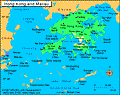
Hong Kong consists of the island of Hong Kong (32 sq mi; 83 sq km), Stonecutters' Island, Kowloon Peninsula, and the New Territories on the adjoining mainland. The island of Hong Kong was ceded to Britain in 1841. Stonecutters' Island and Kowloon were annexed in 1860, and the New Territories, which are mainly agricultural lands, were leased from China in 1898 for 99 years. On July 1, 1997, Hong Kong was returned to China. The vibrant capitalist enclave retains its status as a free port, with its laws to remain unchanged for 50 years. Its first chief executive, Tung Chee-hwa, formulated a policy agenda based on the concept of “one country, two systems,” thus preserving Hong Kong's economic independence.
In a series of massive demonstrations in July 2003, more than 500,000 people took to the streets of Hong Kong to protest proposed antisubversion laws that curtailed civil rights. Surprisingly, Tung Chee-hwa scrapped the law in September. After pro-democracy parties handed pro-China parties a stunning defeat in November elections, China quickly moved to stifle the democracy movement. In April 2004, Beijing officials postponed indefinitely the expansion of the number of popularly elected legislators. Hundreds of thousands protested. Pro-democracy candidates took about 60% of the popular vote in Sept. 2004 elections, but Beijing's legislative system granted them only 40% of the seats in the legislature.
Donald Tsang, with the backing of Beijing, was overwhelmingly reelected as chief executive in March 2007. Tsang was challenged by Alan Leong, the former leader of the Hong Kong Bar Association and an advocate for voting rights in Hong Kong.
China said in December 2007 that Hong Kong citizens will directly elect the chief executive in 2017 elections and the legislature by 2020. However, the candidates will have been approved by the Chinese government. Under the current system, an election committee loyal to the Chinese government elects the chief executive, and a body made up of pro-China business groups elects half of the legislators.
In June and July 2014, the pro-democracy group called Occupy Central held an unofficial referendum on how the island's chief executive will be elected in 2017. About 90% of the 800,000 who voted endorsed giving citizens direct say in the election. Weeks of pro-democracy protests followed the referendum. In late August, China's National Peopleb