
Egypt | Facts & Information

- Egypt Profile
- History
- News and Current Events
Infoplease has everything you need to know about Egypt. Check out our country profile, full of essential information about Egypt's geography, history, government, economy, population, culture, religion and languages. If that's not enough, click over to our collection of world maps and flags.
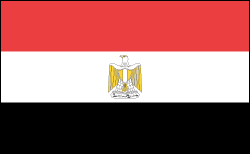
Facts & Figures
-
President: Gen. Abdel Fattah el-Sisi (2014)
Prime Minister: Mostafa Madbouly (2018)
Land area: 384,344 sq mi (995,451 sq km); total area: 386,662 sq mi (1,001,450 sq km)
Population (2022 est.): 107,770,524 (growth rate: 1.68%); birth rate: 21.46/1000; infant mortality rate: 17.7/1000; life expectancy: 74.45
Capital and largest city (2022 est.): Cairo, 21.750 million
Other large cities: Alexandria, 5.484 million; Bur Sa'id, 764,000 (2022)
Monetary unit: Egyptian pound
National name: Jumhuriyat Misr al-Arabiyah
Languages: Arabic (official), English and French widely understood by educated classes
Ethnicity/race: Egyptian 99.6%, other 0.4% (2006 census)
National Holiday: Revolution Day, July 23
Religions: Muslim (predominantly Sunni) 90%, Christian (majority Coptic Orthodox, other Christians include Armenian Apostolic, Catholic, Maronite, Orthodox, and Anglican) 10% (2012 est.)
Literacy rate: 71.2% (2017 est.)
Economic summary: GDP/PPP $1,223,040,000,000 (2020 est.); per capita $12,000. Real growth rate: 4.2%. Inflation: 9.3%. Unemployment: 7.86%. Arable land: 2.8%. Agriculture: cotton, rice, corn, wheat, beans, fruits, vegetables; cattle, water buffalo, sheep, goats. Labor force: 24.113 million (2020); agriculture 25.8%, industry 25.1%, services 49.1% (2015 est.). Industries: textiles, food processing, tourism, chemicals, pharmaceuticals, hydrocarbons, construction, cement, metals, light manufactures. Natural resources: petroleum, natural gas, iron ore, phosphates, manganese, limestone, gypsum, talc, asbestos, lead, zinc. Exports: $40.1 billion (2020 est.): crude oil and petroleum products, cotton, textiles, metal products, chemicals. Major trading partners (exports): United States 9%, United Arab Emirates 6%, Italy 6%, Turkey 6%, Saudi Arabia 6%, India 5% (2019). Imports: $72.48 billion (2020 est.): machinery and equipment, foodstuffs, chemicals, wood products, fuels. Major trading partners (imports): China 15%, Russia 7%, United States 6%, Saudi Arabia 6%, Germany 5%, Turkey 5% (2019).
Communications: Telephones: main lines in use: 9,858,331 (2020); mobile cellular: 95,357,427 (2020). Broadcast media: mix of state-run and private broadcast media; state-run TV operates 2 national and 6 regional terrestrial networks as well as a few satellite channels; about 20 private satellite channels and a large number of Arabic satellite channels are available via subscription; state-run radio operates about 70 stations belonging to 8 networks; 2 privately owned radio stations operational (2019). Internet hosts: 200,430 (2012). Internet users: 73,680,770 (2020).
Transportation: Railways: total: 5,085 km (2014). Roadways: total: 65,050 km; (2018 est.). Waterways: 3,500 km; note: includes Nile River, Lake Nasser, Alexandria-Cairo Waterway, and numerous smaller canals in delta; Suez Canal (193.5 km including approaches) navigable by oceangoing vessels drawing up to 17.68 m (2018). Ports and harbors: Alexandria, Damietta, El Dekheila, Port Said, Suez, Zeit. Airports: 83 (2021).
International disputes: Sudan claims but Egypt de facto administers security and economic development of Halaib region north of the 22nd parallel boundary; Egypt no longer shows its administration of the Bir Tawil trapezoid in Sudan on its maps; Gazan breaches in the security wall with Egypt in January 2008 highlight difficulties in monitoring the Sinai border; Saudi Arabia claims Egyptian-administered islands of Tiran and Sanafir.
Geography
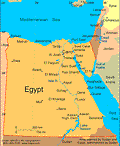
Egypt, at the northeast corner of Africa on the Mediterranean Sea, is bordered on the west by Libya, on the south by the Sudan, and on the east by the Red Sea and Israel. It is nearly one and one-half times the size of Texas. Egypt is divided into two unequal, extremely arid regions by the landscape's dominant feature, the northward-flowing Nile River. The Nile starts 100 mi (161 km) south of the Mediterranean and fans out to a sea front of 155 mi between the cities of Alexandria and Port Said.
Government
Republic.
History
Egyptian history dates back to about 4000 B.C., when the kingdoms of upper and lower Egypt, already highly sophisticated, were united. Egypt's golden age coincided with the 18th and 19th dynasties (16th to 13th century B.C.), during which the empire was established. Persia conquered Egypt in 525 B.C., Alexander the Great subdued it in 332 B.C., and then the dynasty of the Ptolemies ruled the land until 30 B.C., when Cleopatra, last of the line, committed suicide and Egypt became a Roman, then Byzantine, province. Arab caliphs ruled Egypt from 641 until 1517, when the Turks took it for their Ottoman Empire.
Napoléon's armies occupied the country from 1798 to 1801. In 1805, Mohammed Ali, leader of a band of Albanian soldiers, became pasha of Egypt. After completion of the Suez Canal in 1869, the French and British took increasing interest in Egypt. British troops occupied Egypt in 1882, and British resident agents became its actual administrators, though it remained under nominal Turkish sovereignty. In 1914, this fiction was ended, and Egypt became a protectorate of Britain.
Egyptian nationalism, led by Zaghlul Pasha and the Wafd Party, forced Britain to relinquish its claims on the country. Egypt became an independent sovereign state on Feb. 28, 1922, with Fu'ad I as its king. In 1936, by an Anglo-Egyptian treaty of alliance, all British troops and officials were to be withdrawn, except from the Suez Canal Zone. When World War II started, Egypt remained neutral.
Egypt Becomes a Republic
Tensions grew between the Wafd Party and the monarchy following independence, and in 1952, the army, led by Gen. Mohammed Naguib, seized power. Three days later, King Farouk abdicated in favor of his infant son. The monarchy was abolished and a republic proclaimed on June 18, 1953, with Naguib becoming president and prime minister. He relinquished the prime ministership in 1954 to Gamal Abdel Nasser, leader of the ruling military junta. Nasser also assumed the presidency in 1956.
Nasser's policies embroiled his country in continual conflict. In 1956, the U.S. and Britain withdrew their pledges of financial aid for the building of the Aswan High Dam. In response, Nasser nationalized the Suez Canal and expelled British oil and embassy officials. The Soviet Union then agreed to finance the dam and would come to exert increasing influence over Egypt in the coming decade. Israel, barred from the canal and exasperated by terrorist raids, invaded the Gaza Strip and the Sinai Peninsula. Britain and France, after demanding Egyptian evacuation of the canal zone, attacked Egypt on Oct. 31, 1956. Worldwide pressure forced Britain, France, and Israel to halt the hostilities. A UN emergency force occupied the canal zone, and all troops were evacuated in the spring of 1957.
From 1956 to 1961, Egypt and Syria united to form a single country called the United Arab Republic (UAR). Syria ended this relationship in 1961 after a military coup, but Egypt continued to call itself the UAR until 1971.
Tensions Between Egypt and Israel Erupt in the Six-Day War
In 1967, border tensions between Egypt and Israel led to the Six-Day War. On June 5, Israel launched an air assault, and within days had annexed the Sinai Peninsula, the East Bank of the Jordan River, and the Golan Heights. A UN cease-fire on June 10 saved the Arabs from a complete rout. Nasser declared the 1967 cease-fire void along the canal in April 1969 and began a war of attrition. On Sept. 28, 1970, Nasser died of a heart attack. Anwar el-Sadat, an associate of Nasser and a former newspaper editor, became the next president.
The fourth Arab-Israeli War broke out on Oct. 6, 1973, during the Jewish holiday of Yom Kippur. Egypt swept deep into the Sinai, while Syria strove to throw Israel off the Golan Heights. A UN-sponsored truce was accepted on Oct. 22. In Jan. 1974, both sides agreed to a settlement negotiated by the U.S. that gave Egypt a narrow strip along the entire Sinai bank of the Suez Canal. In June, President Nixon made the first visit by a U.S. president to Egypt and full diplomatic relations were established. The Suez Canal was reopened on June 5, 1975.
In the most audacious act of his career, Sadat flew to Jerusalem at the invitation of Prime Minister Menachem Begin on Nov. 20, 1977, to discuss a permanent peace settlement. The Arab world reacted with fury. Egypt and Israel signed a formal peace treaty on March 26, 1979. The pact ended 30 years of war and established diplomatic and commercial relations.
By mid-1980, two-thirds of the Sinai had been transferred back to Egypt, but Sadat halted further talks with Israel in Aug. 1980 because of continued Israeli settlement of the West Bank. On Oct. 6, 1981, Sadat was assassinated by extremist Muslim soldiers at a parade in Cairo. Vice President Hosni Mubarak, a former air force chief of staff, succeeded him. Israel completed the return of the Sinai to Egyptian control on April 25, 1982. Israel's invasion of Lebanon in June brought a marked cooling in Egyptian-Israeli relations, but not a disavowal of the peace treaty.
Egypt Begins Fighting Islamic Extremists
The government has concentrated much of its time and attention in recent years on combating Islamic extremists, who have in particular targeted Copts (Egyptian Christians). In 1997, a terrorist attack on foreign tourists killed 70. During the 1990s, about 26,000 Islamic militants were imprisoned and dozens were executed.
Egypt and Sudan resumed diplomatic relations in March 2000, which had broken off in 1995 after Egypt accused Sudan of attempting to assassinate Hosni Mubarak. Human rights activists have increased their criticism of Egypt for its heavy-handed crackdown on potentially disruptive Islamic groups, and for the harassment of intellectuals advocating greater democracy.
In July 2005, President Mubarak announced he would seek a fifth six-year term. Earlier in the year Mubarak had amended the constitution to allow for multiparty elections, the first in Egyptian history, and on Sept. 6, Mubarak was reelected with 88.6% of the vote. Turnout was 23%.
In March 2007, voters overwhelmingly endorsed changes to the Constitution that strengthened the presidency. Voter turnout was low, at about 27%, and opposition groups claimed the vote was rigged.
U.S. President Obama spoke of forming an alliance with Muslims during a visit to Cairo, Egypt in June 2009. He called for "a new beginning between the United States and Muslims around the world," asking for new alliances based on mutual respect and common interests.
Mubarak Resigns Under Intense Pressure from Protesters
Unrest spread throughout the Middle East in January 2011. First, Tunisia's president Zine al-Abidine Ben Ali stepped down amid widespread protests against corruption, unemployment, and the repressive police state. Demonstrations followed in Yemen and Algeria. In Egypt, opposition groups and activists calling for reform began their protests on January 25—what they called "a day of rage," which coincided with Police Day. The movement, organized using cell phones and social media sites, spread, and protesters took to the streets in several cities, including Cairo, Alexandria, and Suez, demanding the resignation of Mubarak, who had been in power for 30 years. The aging president had taken steps for his son, Gamal, to succeed him in upcoming elections.
The protests continued and grew in size and intensity over the next several days, with protesters and police engaged in violent battles. On January 28, Mubarak ordered his government to resign and reshuffled his cabinet, which had no effect on the protests. Mubarak, however, remained in office, and in an apparent move to cement the support of the military, he appointed military intelligence chief, Omar Suleiman, as vice president. He deployed the military to help police quell the protests, but days later—in a blow to Mubarak—the military said it would not use force against the protesters. On February 1, hundreds of thousands of protesters assembled in Cairo's Tahrir Square. Mohamed ElBaradei, the Egyptian Nobel laureate and former director general of the International Atomic Energy Agency, returned to Egypt and emerged as the leader of the opposition. He urged Muburak to resign and allow the formation of a "national unity government." Wael Ghonim, an Egyptian executive at Google, was a leading force in organizing the protests; he used an anonymous Facebook page and YouTube videos to rally support for the movement. He was jailed for 12 days, and became an unwitting hero of the movement when he acknowledged his role in an emotional television interview after his release.
On Feb. 1, Mubarak announced that he will serve out the remainder of his term but not run for reelection in September. In response, President Barack Obama said an "orderly transition must be meaningful, it must be peaceful, and it must begin now." A day later, however, the situation in Cairo deteriorated abruptly as counter-protests broke out and supporters and opponents of Mubarak faced off in and around Tahrir Square, hurling rocks and wielding sticks. Many observers suspected Mubarak organized and encouraged his supporters to take to the streets in an attempt to further destabilize the country, allowing him to cling to power.
The opposition remained undaunted by the violent counter-protests and continued their demonstrations. The Muslim Brotherhood, the country's largest and most influential opposition movement, had been largely absent from the protest movement until it issued a statement on Feb. 4 calling for the resignation of Mubarak. In response to the continued unrest, the government made a series of conciliatory gestures: it announced that Suleiman would oversee the planning of upcoming elections and the attendant transition, promised a 15% pay increase for government employees, and proposed constitutional reforms. The opposition dismissed the gesture as wildly inadequate, and Mubarak's stubborn insistence on remaining in office emboldened the opposition. Mubarak ultimately gave in to the uprising. On Feb. 11, he announced his resignation and handed power of the country over to the military. Cairo erupted in joyous celebration, with crowds chanting, "Egypt is free!"
Several Milestones Signal Transition to Democracy
After assuming control of the country, the military dissolved Parliament and suspended the Constitution. It then presented a roadmap for a six-month transition to civilian rule. Plans included drafting constitutional amendments, a referendum to vote on them, and elections. Opposition supporters continued to gather in Tahir Square to call for further reform. On March 3 Prime Minister Ahmed Shafiq resigned, giving in to the demands of protesters. He was replaced by Essam Sharaf, a former government minister and a supporter of the opposition. Another milestone was achieved on March 20, when 77.2% of voters approved a referendum on constitutional amendments that lays the groundwork for upcoming legislative and presidential elections. One of the amendments establishes presidential term limits. The amendments were put into effect on March 31, when the ruling military council introduced an interim constitution. The council also said it would cede legislative power after November's parliamentary elections and executive control after presidential elections, which are schedule for November. On April 13, Mubarak and his two sons, Gamal and Alaa, were taken into police custody to be questioned about corruption and abuse of power.
In May, prosecutors charged Mubarak with murder and attempting to murder protesters. He and his sons Alaa and Gamal were charged with corruption. All were ordered to stand trial. Mubarak's trial began on Aug. 3 in Cairo. He appeared in court lying in a hospital bed in a caged area of the courtroom.
Tensions flared between Israel and Egypt in August and September 2011, when militants attacked the Israeli resort town of Eilat, on the Egypt-Israel border. Eight Israelis were killed and 30 were wounded. Six Egyptian border guards were also killed in the shootings. Israeli authorities blamed the attacks on the Popular Resistance Committees, a group that has worked with Hamas, and said they believed the attackers crossed into Israel from Egypt. Egypt in turn blamed Israel for the deaths. Israel responded with several airstrikes on Gaza, killing the Popular Resistance Committees' commander among others. Egyptian officials denied that the attackers crossed through Hamas also denied Israel's accusations. The cross-border attacks threatened the decades of peace between Israel and Egypt. Meanwhile, Palestinian militants fired several rockets into Israel from Gaza, killing one civilian and wounding six others. Hamas, which controls Gaza, took credit for the rockets fired into Israel.
Protesters Return to Tahrir Square
Confidence in the military's leadership began to erode in the fall and hit a low in October 2011 in response to the military's heavy-handed approach to a peaceful protest by Coptic Chrisians, who were demonstrating against religious intolerance and the burning of a church. About 25 Copts were killed and 300 injured in Cairo when security forces fired on the crowd with live ammunition and ran over protests. Days later, the military council said it would maintain control over the government after parliamentary elections and cede power only after a new constitution was adopted and presidential elections. This process was expected to extend into 2013. The moves sparked fear that the military, which still includes members of the Mubarak regime, was postponing the transition to civilian rule in an attempt to retain control and diminish the influence of the democracy movement.
In November, protesters—representing both Islamists and the liberal opposition—returned to Tahrir Square to demand the ruling military council step aside in favor of a civilian-led government. The opposition had little confidence the military would hand over power and suggested that it was actually stifling the revolutionary fervor. The demonstrations turned violent with police firing on crowds with tear gas and rubber bullets. On Nov. 21, as the protests grew in size and intensity and police were widely criticized for their crackdown, Prime Minister Essam Sharaf and his cabinet resigned. In an agreement reached with the Muslim Brotherhood, which had stepped back from the protest movement, the military council vowed to install a civilian prime minister and to accelerate the transition to a civilian government, with presidential elections being held by June 2012. Former prime minister Kamal al-Ganzouri was named to replace Sharaf, and in response to the demands of protesters, the military council transferred most powers of the president to him. The secular opposition condemned the Muslim Brotherhood for cooperating with the military, saying the Islamists were cozying up to the military in a grab for power.
Islamists Fare Well in Parliamentary Elections; Political Turmoil Complicates Presidential Vote
Despite the political turmoil and uncertainty, millions of Egyptians voted in the first round of parliamentary elections on Nov. 28, 2011. The Muslim Brotherhood fared better than expected, winning about 40% of the vote. Even more of a shock was the second place finish of the ultraconservative Islamist Salafists, who took about 25%. The Muslim Brotherhood, however, said it did not plan to form a coalition with the Salafis—an apparent attempt to calm fears that it would assemble an Islamist government. In fact, it said that it planned to form a unity government with secularists and would respect the rights of women and religious minorities.
The second round of parliamentary elections in mid-December were marred by violence. Protesters demonstrating against military rule were beat up and troops assaulted civilians who assembled outside parliament and judges who were enlisted to supervise the vote counting. In response, the civilian advisory council, formed to help the military council gain acceptance with the populace, ceased operations. The move was an embarrassment to the military council. The reputation of the military was further tarnished in late December, when it beat, kicked, and stripped several women who were participating in a women's demonstration against military rule.
After the third and final round of voting, the Muslim Brotherhood emerged as the clear winner, taking 47% of the seats in parliament. The Salafis won 25%, giving Islamists more than 70% of the seats. The first democratically elected parliament in more than 60 years convened in January 2012. Parliament, however, will remain secondary to the military council until the military hands power to a civilian government, which is expected after May's presidential election. The legislative body was charged with forming a committee to write a new constitution. The Muslim Brotherhood named as many as 70 Islamists, including 50 members of parliament, to the 100-person committee. Given its dominance in parliament and control over the new constitution, the Brotherhood said it would not enter a candidate in the presidential election.
About 100,000 protesters gathered in Tahrir Square on January 25, 2012—the first anniversary of the revolution. Rather than a unified demonstration, the gathering turned out to be divisive, with some criticizing the military's continued hold on power, others expressing anger that Muslim Brotherhood's cooperation with the military.
A series of events in March and April 2012 upset the political landscape in Egypt. In March, the Muslim Brotherhood rescinded its earlier pledge not to run a candidate in May's presidential election. The move caused concern in the West, in Israel, and among liberals in Egypt as observers wondered if the Brotherhood had abandoned its vow to follow a course of moderation and was instead seeking a monopoly on power.
Then in early April, a court suspended the work of the constitution-writing committee. Since the constitution will not be written before presidential elections, the new president will control the process, certainly adding a new level of importance to the race. Later in the month, election officials disqualified ten out of 23 candidates in the presidential elections on technical grounds, including three leading contenders: Omar Suleiman, Mubarak's spy chief; Shater; and Hazem Abu Ismail, an ultraconservative Islamist. The first round of Egypt's first democratic presidential election, held on May 23, was inconclusive. The Muslim Brotherhood's Mohamed Morsi and former prime minister Ahmed Shafik faced off in a second round on June 16 and 17.
Two weeks before the run-off election, a smooth transition—or any transition at all—to a democratically elected government seemed impossible when the military council reimposed martial law, dissolved Parliament on a technicality, gave the military legislative and budgetary authority, and released an interim constitution that further eroded the powers of the president. Many Egyptians and observers called the moves a coup. However, the military council recognized the victory of Morsi over Shafik—a sign of hope despite clear challenges ahead. Morsi won 51.7% of the vote. On July 10th—10 days into his presidency—Morsi defied the military and ordered that Parliament be reinstated. Legislators met briefly, and the Supreme Constitutional Court issued a ruling affirming their decision to dissolve Parliament. The moves signaled a protracted power struggle between Morsi and the military.
In late July Morsi named Hesham Kandil, an engineer who served as head of the Ministry of Water Resources and Irrigation during the interim government, as prime minister. Kandil is a Muslim but not a member of the Muslim Brotherhood. Morsi's cabinet, seated in early August, is composed of several former ministers and members of the Muslim Brotherhood, which deflated hopes that the new government would introduce swift change and raised concern that the Brotherhood would attempt to exclude other parties from governance.
Mubarak Sentenced to Life in Prison
On June 2, 2012, a three-judge panel sentenced Mubarak to life in prison for being an "accessory to murder" in the killing of hundreds of unarmed protesters in early 2011. The former president and his sons were acquitted of corruption. However, the panel cleared several of Mubarak's security officials who were responsible for ordering the attacks on protesters. Thousands of demonstrators poured into the streets of Cairo after the verdict was announced to protest what they considered a weak verdict. Mubarak appealed, and in January 2013 the Court of Cassation ordered a retrial. In August 2013, he was transferred from prison to a military hospital in Cairo and has remained there under house arrest.
Protests Threaten Morsi Government
President Morsi faced his first test in early August 2012, when militants shot and killed 16 Egyptian soldiers at an army checkpoint in Egypt's Sinai Peninsula, which borders Israel. Several of the militants then drove into Israel, where their vehicle was destroyed by the Israeli military. Despite increased jihadist activity and warnings about a potential attack in the Sinai, the Egyptian Army was caught unprepared. Morsi ordered an airstrike on the Sinai, which killed about 20 militants. On Aug. 12, Morsi dismissed or "reassigned" several senior generals and the heads of each service branch of the Supreme Council of the Armed Forces (SCAF), an influential force in Egypt that has effectively been in control since the fall of Hosni Mubarak and recently been in a power struggle with the new civilian government. Defense minister Mohamed Hussein Tantawi, a power broker in Egypt, was among the leaders Morsi stripped of his position. Morsi also voided a constitutional declaration imposed by the military that limited the role of the president, and implemented a new order that vastly expanded his power and that of the legislature. The bold move sent a clear message that the civilian government had taken back control of the country.
The attack in the Sinai highlighted the importance—and fragility—of the relationship between Israel and Egypt in dealing with the explosive nature of the region.
Protests broke out at the U.S. embassy in Cairo in September over the release of a YouTube film, Innocence of Muslims, which insulted the Prophet Muhammad and criticized Islam. Demonstrators stormed the walls of the embassy and ripped down the American flag. President Morsi was slow to respond to the protests and issued only a tepid condemnation of the violence, prompting a call from President Barack Obama, who warned that relations between the U.S. and Egypt will suffer if he fails to take stronger action against anti-American violence. The protests coincided with similar actions in Yemen, Tunisia, Morocco, Sudan, Indonesia, and Pakistan. In Libya, the U.S. ambassador, Christopher Stevens, and three other embassy officials were killed by armed gunmen.
In November 2012 as violence intensified between Israelis and members of Hamas in the Gaza Strip, President Morsi held indirect talks with Hamas and the Israeli government in an attempt to prevent further destabilization in the region. On Nov. 21, Egyptian foreign Mohamed Kamel Amr and U.S. secretary of state Hillary Clinton announced a cease-fire had been signed.
Any praise that Morsi received for intervening in the Gaza crisis was quickly overshadowed by a brazen power grab announced on November 22, in which he declared authority over the courts, thereby removing any check on his actions by the courts. He said the move was necessary because the judiciary, made up of Mubarak appointees, was threatening to suspend the constitutional assembly before it completed the task of drafting a new constitution. Progress on writing a new constitution had been stalled by members of the opposition on the committee. Morsi also said the edict would bring "political, social and economic stability" and remove barriers to a smooth transition of power. The decree was met with large protests in Tahrir Square, the scene of the uprising against Mubarak, and international condemnation. It also fueled accusations that one autocrat had succeeded another.
Days later—on November 26—Morsi seemed to have backtracked in repsonse to the outpouring of rage, saying only "acts of sovereignty" would be exempt from judicial oversight. The clarification did little to placate his opponents. Under threat of being suspended by the courts, the constitutional assembly hastily approved a draft document on Nov. 29. The constitution satisfied some of the demands of the revolutionaries by weakening the presidency and strengthening Parliament and banning torture, however it was criticized for affirming the power of the military and potentially limiting the rights of women and religious minorities. The draft constitution passed because Morsi's opponents on the committee from secular groups and Coptic Christians boycotted the vote. Thousands of protesters took to the streets to demonstrate against Morsi's power grab. The protests turned violent when members of the Muslim Brotherhood tried to break up the crowds. Several people were killed in the fighting between the opposing sides. Morsi and about a dozen members of the Muslim Brotherhood were accused of inciting the murder of a journalist and two opposition figures, and the ordering torture and the illegal detention of protesters. The referendum on the constitution was held in December, and about 64% of voters approved it. Turnout, however, was low—less than 33%.
Violent protests erupted throughout Egypt on January 25, 2013, the second anniversary of the revolution. Demonstrators focused their ire on the Muslim Brotherhood and President Mohamed Morsi's government, frustrated that the country was headed on an ideologically conservative path under the Islamists and that Morsi has failed to bolster the economy or fulfill promises to introduce broader civil liberties and social justice. As the protests continued and dozens of people were killed in the violence, Morsi declared a state of emergency in three large cities: Suez, Ismailia, and Port Said. The violence was particularly gruesome in Port Said after 21 people were sentenced to death for their role in the deadly brawl at a Feb. 2012 soccer match that resulted in the death of about 75 people. Defying the state of emergency and attendant curfew, rioters, who were upset with the verdict, wreaked havoc throughout the city, attacking police stations, a power plant and a jail. At least 45 people died in Port Said alone. News reports indicated the victims were shot by police. Police also reportedly shot live ammunition and tear gas at protesters in other cities, including Cairo.
In March 2013, Morsi called for early parliamentary elections, to be held in April. The main opposition coalition, the National Salvation Front, said it would boycott the vote, claiming the elections would not be free or fair. A court, however, cancelled the election in early March, saying Morsi did not clear the election schedule with the his cabinet or the prime minister.
Morsi Deposed by Military After One Year in Office
Massive anti-government protests took place on June 30, 2013, the first anniversary of Morsi's inauguration. As many as one million people took the streets in the planned demonstrations and called for the president to step down. Protesters ranged from the poor to anti-Islamists to the wealthy and middle class. Their complaints against Morsi were far-reaching: the dismal state of the economy (high inflation, poverty and unemployment), Morsi's installation of members of the Muslim Brotherhood into many positions of power, his failure to stem the sectarian divide between Sunnis, Shiites, and Christians, among other issues. The protests continued on July 1, and the military issued a statement saying they would step in if Morsi did not respond to the protesters in 48 hours. On July 4, the military deposed Morsi and suspended the constitution, saying the move was an attempt at "national reconciliation" rather than a coup. Morsi, however, called it a "complete military coup.” He was arrested and taken into custody and several members of his inner circle were placed under house arrest. Adli Mansour, the chief justice of the Supreme Constitutional Court, was sworn in as interim president and Mohamed ElBaradei, diplomat and opposition leader, became vice president. Mansour dismantled the Shura Council, the only functioning body of parliament. Thousands of Morsi supporters took to the streets of Cairo on July 5 in protests organized by the Muslim Brotherhood. Troops and police fired on protesters during morning prayers on July, killing more than 50 Morsi supporters and wounding more than 300. Reports in the news media said the attack was unprovoked. However, the military said soldiers were fired at first. About 650 members of the Muslim Brotherhood were arrested. The violence escalated the political crisis.
The day after the violence—the worst since the revolution began in 2011—the interim military government named Hazem el-Beblawy, a respected economist who supported the ouster of Mubarak, as prime minister and said a new constitution would be drafted and elections would be held within six months. The Muslim Brotherhood, however, rejected both the apppointment of Beblawy and the timeframe for a return to a civilian government. Most members of the opposition, ranging from liberals to conservative Islamists, called the timeframe unrealistic and poorly planned. On July 16, an interim government took office. It's composed mostly of left-leaning technocrats and three Christians and two women were given posts. Notably, there are no Islamists in Beblawy's cabinet. Gen. Abdel Fattah el-Sisi, who organized the coup, was named deputy prime minister and retained his post as head of defense. The Muslim Brotherhood and the Nour party, which had backed the coup, rejected the new government. The government faces the overwhelming tasks of shoring up the economy, shepharding the country back to civilian rule, writing a new constitution, and holding elections within six months.
Military Brutally Cracks Down on Protesters
At the urging of Gen. Sisi, who wields more influence over the country than the interim government, hundreds of thousands of protesters took to the streets on July 26 to show support for the military and to demand that the country "confront terrorism." The next day, members of the Muslim Brotherhood staged their own demonstration—a sit-in—in Cairo in support of Morsi, and police opened fire, killing more than 80 people and wounding several hundred. Despite the escalating violence, the Islamists continued the sit-ins and set up protest camps. On August 14 riot police raided the camps. They opened fire and used armored bulldozers, tear gas, snipers, and helicopters to clear the camps. Protesters threw rocks and burned tires in response. More than 500 people were killed, and the government declared a state of emergency. Mohamed ElBaradei resigned as vice president in protest of the military's action. President Barack Obama canceled joint military exercises between Egypt and the U.S. that were scheduled for September in response to the military's repressive and heavy-handed tactics. “While we want to sustain our relationship with Egypt, our traditional cooperation cannot continue as usual while civilians are being killed in the streets,” Obama said.
The crackdown and protests dragged on for several days, as both the military and Morsi's supporters vowed to continue their fight. Casualties mounted with more than 1,000 fatalities, most of whom were Morsi supporters. On Aug. 18, 36 Islamic militants in police custody were killed while being transported to prison on the outskirts of Cairo, and on Aug. 19 militants killed 24 police officers in the northern Sinai region. Foreign governments urged the military to use restraint, a plea largely ignored. While foreign officials deplored the heavy-handed tactics of the military, they were careful not to imply support for the protesters, recognizing that the interim government was the only hope for stability. On Aug. 19, police arrested Mohamed Badie, the Muslim Brotherhood’s spiritual leader, and charged him with incitement to murder. In addition, on the same day a court ordered that former president Hosni Mubarak be released from prison, saying the appeals process had reached an end. He was released from prison on Aug. 22 and placed under house arrest. The government of Morsi kept Mubarak in prison during the appeals process by adding new charges—a precedent Gen. Sisi evidently refused to follow.
By the end of August, the protests had mostly come to an end. After seven weeks of unrest, about 2,000 people were killed, including about 200 police officers, and about 1,500 members or sympathizers of the Muslim Brotherhood had been detained. In September, the Cairo Court for Urgent Matters issued an injunction barring the Muslim Brotherhood from carrying out any activity in the country and confiscated its assests, effectively shutting down the organization. The turn of events called into question whether the 2011 revolution would be in vain. Indeed, all signs indicated that Egypt was headed back to becoming an authoritarian regime.
Violence erupted again in early October when members of the Muslim Brotherhood took the streets in Cairo and their peaceful protests were met with gunfire by riot police. More than 50 members of the brotherhood were killed. In response to the continued violent crackdown on the Muslim Brotherhood, President Obama announced that the U.S. would temporarily suspend financial and military aid to Egypt, including Apache helicopters, F-16 warplanes, and $260 million. In an attempt to maintain a strategic relationship with Egypt, the U.S. will continue to provide assistance to fight terrorism, train troops, and secure Egypt's borders and the Sinai.
Morsi's trial on charges of inciting the murder of protesters opened briefly in early November and was adjorned until January 2014. He denounced the court as illegitimate and proclaimed himself the leader of Egypt. Fourteen other defendants also appeared in court, and they as well as Morsi were held in a caged area of the courtroom. The government declared the Muslim Brotherhood a terrorist organization in December, following an attack that killed a dozen people in Mansoura.
Voters Approve New Constitution
A draft of the new constitution—replacing the one adopted under Morsi—was released in early December. While it includes provisions that protect citizens, including a ban on torture, human trafficking, and violence against women, the constitution expanded the powers of the police and security forces and the military. It also outlaws religious political parties, which means Islamist parties such as the Muslim Brotherhood would be banned. The constitution was put to a referendum on Jan. 14 and 15, 2014, and 98% voted in favor. The Muslim Brotherhood boycotted the vote. Turnout was 38%, but less than 20% for voters under age 30.
Thousands of people took to the streets of Cairo on Jan. 25, 2014, the third anniversary of the uprising against the autocratic former president Hosni Mubarak, both to commemorate the revolt and to support Gen. Sisi. In other parts of the city and in surrounding areas, violence broke out between rival anti-government groups, including Islamists and secularists. About 50 people were killed.
In February 2014, Mubarak and his sons Alaa and Gamal were charged with using more than $17 million in state funds for renovations on their private homes. They were found guilty of embezzlement in May. Hosni Mubarak was sentenced to three years in prison and his sons four years. They were also fined $3 million and ordered to pay back the $17 million.
Prime Minister Hazem el-Beblawy and several members of his cabinet resigned abruptly on Feb. 24, 2014. Beblawy did not give a reason for stepping down. He had been in office since July 2013, and has dealt with a series of daunting challenges, including an economy in tatters, continued protests, and labor strikes. He was replaced by Ibrahim Mehlib, an industrialist who served as housing minister under Mubarak.
Mass Death Sentences Handed Down in Killing of Officer
After a two-hour trial, a judge in Matay in Minya Province sentenced 529 people to death in March 2014 for the killing of a police officer during the protests against the ouster of Islamist President Mohamed Morsi in August 2013. About 400 people were sentenced in absentia. It was a stunning verdict that met with international condemnation. Fearing reprisals from the military-led government, few Islamists dared to speak out or demonstrate against the verdict. A similar verdict was rendered by the same court in April, with more than 680 people being sentenced to death in connection to the police officer's death. Those sentenced included Mohamed Badie, the spiritual leader of the Muslim Brotherhood. Most of those sentenced were either members of the Muslim Brotherhood or supporters of the group. In another ruling in April, a court in Cairo banned the April 6 movement, the liberal group that organized the rebellion that led to the ouster of Mubarak. Despite these repressive, anti-democratic actions, the U.S. announced it would resume some aid to Egypt and deliver 10 Apache helicopters to the Egyptian military.
Voter Turnout Unexpectedly Low in Presidential Election
Abdul-Fattah Sisi, the influential general who led the ouster of Morsi, resigned as defense minister in March 2014 and announced his intention to run for president in the upcoming election.
Voter turnout in May 2014's presidential election was so low that officials added a third day of voting and declared the added day a state holiday. Sisi won the election in a landslide, taking 95% of the vote, but the turnout, about 47%, suggested that Sisi did not have the overwhelming support he had claimed and was widely reported. This may make it difficult for Sisi to implement economic reforms that are needed to boost the country's dire financial situation. In the 2012 presidential election, 52% of voters cast ballots. Observers feared that under Sisi, a military strongman, Egypt would revert to an autocracy as seen in the Mubarak era.
In June 2014, an Egyptian court convicted three Al Jazeera English journalists of aiding the Muslim Brotherhood and spreading false news during their coverage of the protests that followed the ouster of President Mohamed Morsi in July 2013. Peter Greste, Mohamed Fahmy, and Baher Mohamed were arrested in December 2013. Greste and Fahmy were sentenced to seven years in prison, and Baher Mohamed received a 10-year sentence. The extra years were for possessing ammunition, which amounted to one bullet from the protests he kept as a keepsake. The prosecution did not present any evidence against the journalists, and the verdict prompted international condemnation. The White House issued a statement saying the ruling "flouts the most basic standards of media freedom and represents a blow to democratic progress in Egypt." The ruling sent a clear message to journalists and the public that the Sisi government would likely continue to crack down on freedom of the press and would not tolerate dissent.
Dangerous Jihadist Group Intensifies Attacks on Troops; Pledges Allegiance to ISIS
In the summer and fall of 2014, the jihadist group Ansar Beit al-Maqdis, the most virulent militant organization in Egypt, intensified its anti-government activity with a series of brutal attacks on security troops. At least 20 were killed in July in western Egypt and more than 30 soldiers were killed in late October in the Sinai Peninsula. In response, the government evacuated residents and destroyed nearly 800 homes on the border with Gaza to rid the area of "terrorist hotbeds" and to create a buffer zone to stop the flow of weapons and fighters between Egypt and Palestinians. The Sinai-based Ansar Beit al-Maqdis, which translates to "Supporters of Jerusalem," stepped up its attacks on police and security forces after the ouster of Islamist President Mohamed Morsi in August 2013. In November, the group pledged allegiance to the Islamic State in Iraq and Syria (ISIS), the Sunni militant organization that has terrorized Iraq and Syria in its bid to implement an Islamic state.
In February 2015, a group of Libyan militants aligned with ISIS beheaded 21 Egyptian Coptic Christians who had been kidnapped from Sirte, Libya. Egypt responded by launching airstrikes on weapons Derna, a militant stronghold in eastern Libya.
Court Drops Charges Against Mubarak
In November 2014, an Egyptian court dropped all charges against former president Hosni Mubarak for his role in the killing of hundreds of unarmed protesters in the Arab Spring protests of 2011. His security chief and several high-ranking police officials were also cleared. Thousands of people protested the verdict in Tahrir Square. With another strongman in the role as president, the ruling largely turned back the clocks on the Arab Spring protests.
Obama Lifts Freeze on Military Aid
In March 2015, President Barack Obama lifted the freeze on financial and military aid to Egypt that was imposed in 2013 following the ouster of President Mohamed Morsi and the violent crackdown on the Muslim Brotherhood by the military. President Abdel Fattah el-Sisi was a leader in the coup against Morsi and was in power when the military suppressed Muslim Brotherhood protests. Sisi has not improved his human rights record or made progress towards democratization, which Obama said was necessary for a resumption of aid, but the Obama administration said the move was in the "interest of U.S. national security." With the rise of ISIS, turmoil in Yemen, and political chaos in Libya, Egypt, a longtime ally of the U.S., needs to be able to defend itself in the face of such instability.
Morsi Receives Sentences of Death and 20 Years in Prison
In April 2015, Morsi and 14 members of the Muslim Brotherhood were found guilty of ordering the torture and illegal detention of protesters. They were sentenced to 20 years in prison. The charges stem from violent protests against Morsi in December 2012. They were acquitted of inciting the murder of a journalist and two opposition figures. In May 2015, Morsi was sentenced to death in a separate case involving a prison break of scores of members of the Muslim Brotherhood in 2011. An Egyptian court upheld Morsi's death sentence in June.
Insurgent Attacks Increase
Egypt's Prosecutor-General Hisham Barakat was killed by a roadside bomb in late June 2015. He was the highest-ranking official killed since the insurgency against the government began in 2013. No group claimed responsibility for the assassination, but Barakat was known for taking a hard line against Islamists. Days later, a group linked to the Islamic State launched coordinated attacks in Northern Sinai that killed about 20 soldiers. The attack underscored Sisi's failure to crack down on Islamist groups. The ongoing violence has thwarted an economic recovery and discouraged tourism.
Egypt Joins in Saudi-Led Fight Against Rebels in Yemen; Prime Minister, Cabinet Resign
Despite the launch of an aggressive Saudi-led campaign on Houthi targets, Houthi rebels continued to gain ground in Yemen throughout 2015. Saudi Arabia led a coalition of Middle East nations in the fight. Egypt sent about 800 ground troops to Yemen in September.
In September, Prime Minister Ibrahim Mehlib and his cabinet resigned amid widespread allegations of corruption involving Mehlib and several ministers. The charges include embezzlement and accepting bribes.
See also Encyclopedia: Egypt .
U.S. State Dept. Country Notes: Egypt
Trending
Here are the facts and trivia that people are buzzing about.




