Geography
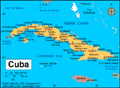
The largest island of the West Indies group (equal in area to Pennsylvania), Cuba is also the westernmost—just west of Hispaniola (Haiti and the Dominican Republic), and 90 mi (145 km) south of Key West, Fla., at the entrance to the Gulf of Mexico. The island is mountainous in the southeast and south-central area (Sierra Maestra). It is flat or rolling elsewhere. Cuba also includes numerous smaller islands, islets, and cays.
Government
Communist state.
History
Arawak (or Taino) Indians inhabiting Cuba when Columbus landed on the island in 1492 died from diseases brought by sailors and settlers. By 1511, Spaniards under Diego Velásquez had established settlements. Havana's superb harbor made it a common transit point to and from Spain.
In the early 1800s, Cuba's sugarcane industry boomed, requiring massive numbers of black slaves. A simmering independence movement turned into open warfare from 1867 to 1878. Slavery was abolished in 1886. In 1895, the poet José Marti led the struggle that finally ended Spanish rule, thanks largely to U.S. intervention in 1898 after the sinking of the battleship Maine in Havana harbor.
An 1899 treaty made Cuba an independent republic under U.S. protection. The U.S. occupation, which ended in 1902, suppressed yellow fever and brought large American investments. The 1901 Platt Amendment allowed the U.S. to intervene in Cuba's affairs, which it did four times from 1906 to 1920. Cuba terminated the amendment in 1934.
In 1933, a group of army officers, including army sergeant Fulgencio Batista, overthrew President Gerardo Machado. Batista became president in 1940, running a corrupt police state.
In 1956, Fidel Castro Ruz launched a revolution from his camp in the Sierra Maestra mountains. Castro's brother Raul and Ernesto (Ché) Guevara, an Argentine physician, were his top lieutenants. Many anti-Batista landowners supported the rebels. The U.S. ended military aid to Cuba in 1958, and on New Year's Day 1959, Batista fled into exile and Castro took over the government.
Bay of Pigs Disaster
In 1961, a U.S.-backed group of Cuban exiles invaded Cuba. Planned during the Eisenhower administration, the invasion was given the go-ahead by President John Kennedy, although he refused to give U.S. air support. The landing at the Bay of Pigs on April 17, 1961, was a fiasco. The invaders did not receive popular Cuban support and were easily repulsed by the Cuban military.
Soviet-Missile Crisis
A Soviet attempt to install medium-range missiles in Cuba—capable of striking targets in the United States with nuclear warheads—provoked a crisis in 1962. Denouncing the Soviets for “deliberate deception,” President Kennedy promised a U.S. blockade of Cuba to stop the missile delivery. Six days later, Soviet premier Nikita Khrushchev ordered the missile sites dismantled and returned to the USSR in return for a U.S. pledge not to attack Cuba.
The U.S. established limited diplomatic ties with Cuba on Sept. 1, 1977, making it easier for Cuban Americans to visit the island. Contact with the more affluent Cuban Americans prompted a wave of discontent in Cuba, producing a flood of asylum seekers. In response, Castro opened the port of Mariel to a “freedom flotilla” of boats from the U.S., allowing 125,000 to flee to Miami. After the refugees arrived, it was discovered that their ranks were swelled with prisoners, mental patients, homosexuals, and others unwanted by the Cuban government.
Cuba fomented Communist revolutions around the world, especially in Angola, where thousands of Cuban troops were sent during the 1980s.
Russian aid, which had long supported Cuba's failing economy, ended when Communism collapsed in eastern Europe in 1990. Cuba's foreign trade also plummeted, producing a severe economic crisis. In 1993, Castro permitted limited private enterprise, allowed Cubans to possess convertible currencies, and encouraged foreign investment in its tourist industry. In March 1996, the U.S. tightened its embargo with the Helms-Burton Act.
Christmas became an official holiday in 1997 as a result of Pope John Paul II's 1998 visit to Cuba, raising hopes for greater religious freedom.
In June 2000, Castro won a publicity bonanza when the Clinton administration sent Elian Gonzalez, a young Cuban boy found clinging to an inner tube near Miami, back to Cuba. The U.S. Cuban community had demanded that the boy remain in Miami rather than be returned to his father in Cuba. By many accounts, the influential Cuban Americans lost public sympathy by pitting political ideology against familial bonds.
In March and April 2003, Castro sent nearly 80 dissidents to prison with long sentences, prompting an international condemnation of Cuba's harsh supression of human rights.
The Bush administration again tightened its embargo in June 2004, allowing Cuban Americans to return to the island only once every three years (instead of every year) and restricting the amount of U.S. cash that can be spent there to $50 per day. In response, Cuba banned the use of dollars, which had been legal currency in the country for more than a decade.
In July 2006, Castro—hospitalized because of an illness—temporarily turned over power to his brother Raúl. In October, it was revealed that Castro has cancer and will not return to power.
In Poor Health Castro Announces His Retirement
Seventeen months after his emergency intestinal surgery, 81-year-old Castro released a public statement declaring that he was not healthy enough to campaign in the upcoming parliamentary elections, although he has not withdrawn from the election. Castro's announcement on January 2008, was followed by a national television broadcast showing a recent meeting between Castro and President Luiz Inacio Lula da Silva of Brazil where he told the Brazilian president that he was feeling very well.
During the Jan. 2008 parliamentary elections, both Fidel and Raúl Castro were reelected to the National Assembly as well as 614 unopposed candidates.
In Feb. 2008, Fidel Castro ended 49 years of power when he announced his retirement. The 81-year-old, who ruled Cuba since leading a revolution in 1959, said he would not accept another term as president. Raúl Castro succeeded his brother, becoming the 21st president of Cuba on Feb. 24, 2008.
Cubans Begin to Win Small Freedoms
At the UN in Feb. 2008, Foreign Minister Felipe Pérez Roque signed the International Covenant on Civil and Political Rights and the International Covenant on Economic, Social, and Cultural Rights. The Covenants ensure citizens' political and civil freedom, and gaurantee the right to work, fair wages, social security, education, and high standards of physical and mental health. Roque also announced that in 2009 the United Nations Human Rights Council will be allowed to examine Cuba at will.
The government relaxed land restrictions for private farmers in July 2008, in an effort to boost the country's poor food production and reduce dependence on food imports.
The U.S. Congress voted in March 2009 to repeal the long-standing restrictions on Cuban-Americans visiting Havana and sending money into the country. President Obama has signaled a willingness to establish warmer ties with Cuba, a subtle acknowledgement that isolation has not been effective in forcing the Castro regime from power.
Castro made the surprise announcement in July 2010 that he plans to release 52 political prisoners. The prisoners—activists and journalists—have been held since a 2003 crackdown on dissidents. Fidel Castro said the activists were "mercenaries" acting at the request of the United States.
Cuba Takes Possible Steps Toward a New Leader Not Named Castro
On April 19, 2011, Cuba made the most significant change to its leadership in over 50 years, by appointing José Ramón Machado to fill the second-highest position in the Communist Party. It was the first time since the 1959 revolution that someone other than the Castro brothers has been named to the position. The appointment was made at the party's first congress in 14 years and coincides with several changes being made to allow for more private enterprise in Cuba.
In October 2011, buying and selling cars became legal. Also, Raul Castro started allowing Cubans to go into business for themselves in a variety of approved jobs, from accounting to food vendors. The following month, the government began allowing real estate to be bought and sold for the first time since the days immediately following the revolution. A new law, applying only to permanent residents, went into effect on November 10. The law, an effort to prevent massive real estate holdings, limits Cubans to owning one home in the city and one in the country. The new law also requires that all new real estate transactions be made through Cuban bank accounts for regulation purposes.
In December 2011, the government pardoned more than 2,900 prisoners. Of those pardoned, 86 were foreigners; however, Alan Gross was not one of them. Gross, an American contractor, has served a 15-year sentence since 2009 for distributing satellite telephone equipment in Cuba. His case has dampened President Obama's efforts to improve relations between the United States and Cuba.
Pope Makes Long-Awaited Visit
On March 26, 2012, Pope Benedict XVI visited Cuba. The three-day visit came after years of tension between the church and the Cuban government. It was the first papal trip since Pope John Paul II visited 14 years ago. During his visit, Pope Benedict XVI, pushing for Cuba toward freedom, said, "I am convinced that Cuba, at this moment of particular importance in its history, is already looking to the future, and thus is striving to renew and broaden its horizons."
Around 200,000 attended the Mass in Santiago de Cuba, including people from as far as Miami. However, many attendees said they were pressured to attend by employers or members of the Communist Party. One attendee was removed by security after he started shouting negative comments about the government.
Exit Visa Requirement Is Dropped
On October 16, 2012, the government announced that in early 2013 Cubans would no longer be required to have an exit visa when leaving the country. This new policy was promised by President Raúl Castro in 2011 as a way to answer the rising calls for change by Cubans.
The new policy states that as of January 13, 2013, Cubans could leave the country on vacations or forever. They would only need a valid passport and a visa from the country of their destination. It also stated that Cubans could stay abroad longer, up to two years before they lose their citizenship and benefits. However, the new policy also stated that Cubans could be stopped from leaving the country for "defense and national security" reasons. This part of the new law suggested that while Castro and the Cuban government were answering the demands for change, they were also maintaining tight control of political dissidents.
Cuba Resumes Diplomatic Relations with U.S.
The Cuban government freed U.S. aid contractor Alan Gross, who had been in captivity for five years, on Dec. 17, 2014. Gross had been sentenced to 15 years in prison in 2011 after his effort to create a way to communicate outside of the Cuban government's control. The government cited humanitarian grounds as the reason for Gross' release.
In response to the prisoner release, U.S. President Barack Obama announced that the U.S. would resume full diplomatic relations with Cuba, which includes opening an embassy in Havana. There hasn't been any diplomatic relations between the U.S. and Cuba since 1961. The prisoner release was part of a deal negotiated in secret over 18 months. Canada hosted most of the talks that led to the deal. Pope Francis also hosted a meeting at the Vatican to help with negotiations between the two countries.
Talks began in early 2015 between the two countries over how to restore diplomatic relations after five decades. Both sides made demands ahead of the talks. Cuba asked the U.S. to remove its name from a list of states that sponsor terrorism. The U.S. insisted that its diplomats should be allowed to work freely and meet with dissidents in Cuba. A second round of talks was scheduled for late Feb. to hammer out these issues and more. Meanwhile, reaction to the resumed relations with the U.S. has been mixed in Cuba. Some praised the move while others were skeptical.
With diplomatic relations restored, the ban for Americans traveling to Cuba was lifted. Before Dec. 2014, Americans could only travel to Cuba with permission from the U.S. State Department. After Dec. 2014, tourists from the U.S. still had to go as part of a religious, educational, and cultural group, but the travel ban being lifted made it easier in other ways for Americans visiting Cuba. Internet access, an embassy, and the use of credit cards were soon available for the first time to assist Americans while in Cuba. Also, the U.S. government began allowing Americans to bring small quantities of items back from Cuba, including cigars. Cuban cigar makers estimated that their sales would increase from $3 million to $6 million in 2015, due to the new rule.
President Obama and Cuban President Raul Castro met at the Summit of the Americas in Panama in April. It was the first time the countries' leaders held a face-to-face meeting in more than 50 years. According to news reports, Obama and Castro vowed to open embassies in both countries. "Our governments will continue to have differences," Obama said. "At the same time, we agreed that we can continue to take steps forward that advance our mutual interests."
In another step toward resuming full diplomatic relations, the U.S. removed Cuba from its list of state sponsors of terrorism in May 2015. Of the decision, U.S. State Department spokesman Jeff Rathke says in a statement, "While the United States has significant concerns and disagreements with a wide range of Cuba's policies and actions, these fall outside the criteria relevant to the rescission of a state sponsor of terrorism designation."
Cuba and the U.S. announced on July 1, 2015, that embassies would open in Washington D.C. and Havana. The U.S. Embassy in Havana was opened later that month. The reestablishment of embassies was another major step in rebuilding relations between the two countries.
In early Feb. 2016, another major step in relations between the two countries took place when plans for President Obama to visit Cuba were announced. The last and only president to visit Cuba was Calvin Coolidge in 1928. Obama's historic visit occurred in March. Obama and Cuban president Raul Castro appeared at a news conference together at the Revolutionary Palace. While both were cordial, both presidents challenged the policies of each other's country. Obama criticized Cuba's policy on human rights, and Castro challenged the income gap in the U.S. and the country's failure to provide universal health care. In a speech at the Grand Theatre, where President Coolidge spoke nearly 90 years ago, Obama said, "I have come here to bury the last remnant of the Cold War in the Americas." He also said Castro "need not fear the different voices of the Cuban people ? and their capacity to speak, and assemble, and vote for their leaders." Obama and his family attended a baseball game between the Tampa Bay Rays and the Cuban national team during their visit.
See also Cuba Primer
Encyclopedia: Cuba
U.S. State Dept. Country Notes: Cuba
National Statistical Office (In Spanish Only) http://www.cubagob.cu/otras_info/estadisticas.htm .