
DK Science: Space Observatories
High above the Earth’s atmosphere, space observatories such as the HUBBLE SPACE TELESCOPE can view the Universe much more clearly than observatories on the ground. They can also pick up different, invisible forms of radiation that the atmosphere absorbs, such as gamma rays, X-rays, ultraviolet rays, and infrared rays. By looking at these different wavelengths, astronomers can better understand how the Universe works.
Gamma rays have the shortest wavelengths and the most energy. They are produced by some of the most violent events in the Universe, such as colliding galaxies.
High-energy X-rays are also emitted when violent events occur in the Universe. They carry more energy than visible light and have longer wavelengths than gamma rays. Here they are being emitted by the scattered debris from a supernova explosion.
This ultraviolet image of the Sun reveals different temperatures in the corona. Ultraviolet rays also have more energy than visible light, but less than X-rays. They come from very hot objects, such as the Sun. These are the rays that can burn the skin.
Infrared rays have longer wavelengths than visible light. On Earth they are felt as heat, and are also known as heat rays. In space they penetrate interstellar dust and reveal what is behind it.
When it was launched in 1991, the Compton Gamma Ray Observatory was the biggest space observatory ever. It mapped hundreds of gamma ray sources and recorded more than 2,500 gamma ray bursts, signs of the most violent happenings in the Universe.
The 13.7-m (45-ft) long Chandra X-ray Observatory is the world’s most powerful X-ray telescope. In 1999, it was deployed from the Space Shuttle and then boosted into a highly elliptical orbit that took it 140,000 km (87,000 miles) above Earth.
Since 1995, the Solar and Heliospheric Observatory (SOHO) has kept watch on the Sun at ultraviolet and visible light wavelengths. It is located in solar orbit 1.5 million km (930,000 miles) from Earth. SOHO investigates the Sun’s surface, its interior, and its outer atmosphere, the corona.
Launched in 2003, the Spitzer Space Telescope is the largest infrared telescope in space. It observes the Universe at invisible, infrared wavelengths. The Spitzer looks at the cooler objects in space, such as small, dim stars, extrasolar planets (planets round other stars), and giant clouds between the stars. To make it ultrasensitive, its instruments are cooled by liquid helium to around -273°C (-459°F).
Some of the most stunning images ever obtained of our Universe have been sent back by the Hubble Space Telescope (HST). It works in mainly visible light, but can also take infrared images. It was launched in 1990 from the space shuttle Discovery, and since then has been serviced and updated four times by shuttle astronauts.
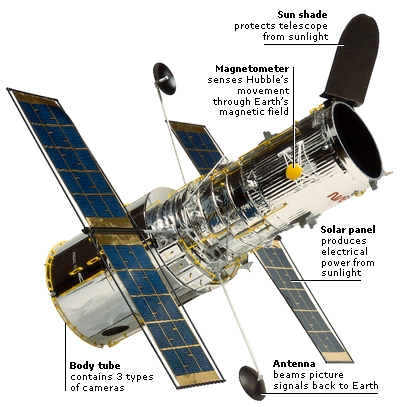
Inside the body tube is a conventional reflecting telescope. A curved primary mirror 2.4 m (8 ft) across collects incoming light and reflects it onto a secondary mirror along the tube. This secondary mirror reflects and focuses the light through a hole in the primary mirror. The light is then fed to the cameras and other instruments. Hubble is controlled at NASA’s Goddard Space Flight Center, Maryland, USA. Engineers there monitor the telescope and operate the telescope remotely, as instructed by astronomers based in Baltimore, USA.
