
DK Science: Pressure
When you press or push something, the force you apply is called pressure. Pressure is measured as the force you use divided by the area over which you use it. If you use a bigger force, or if you use the same force over a smaller area, you increase the pressure. We experience AIR PRESSURE all the time because of the weight of air pressing in on our bodies. WATER PRESSURE increases as you go deeper in the ocean.
The gases in Earth’s atmosphere are made up of tiny molecules that are constantly crashing into your body and trying to press it inwards. This pressing force is called air pressure. It is greatest at ground level where there are most air molecules. At greater heights above Earth, there are fewer air molecules and the air pressure is much less. It is possible to compress (squeeze) air, and this is used to inflate vehicle tyres and to power machines such as pneumatic drills.
Heavy construction machines have large tyres for two reasons. The compressed air in the tyre helps to absorb bumps, so the ride is much smoother than it would be with a solid wheel. Large tyres also help to spread the weight of the machine over a much bigger area. This reduces the pressure on the ground and stops the machine sinking into the mud.
Water behaves differently from air when it is under pressure. It cannot be compressed (squeezed). This makes it useful for transmitting force in machines, using a system called hydraulics. Water is also heavier than air, and an increase in water pressure affects humans more than a drop in air pressure. Even with a snorkel or other breathing apparatus, it feels much harder to breathe underwater. The water above you presses down from all sides on your body, so your lungs find it harder to expand to take in air. The deeper you go, the more water there is above you and the greater the pressure on your body.
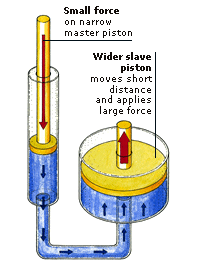
Liquid pressure is used to carry force through pipes. The small force pushing down does not compress the liquid but moves through the liquid to push another piston a small distance upwards. The wider area of this piston increases the force applied.
The higher we go, the less air there is in the atmosphere above us. The deeper in the sea we go, the more water there is pressing down on us.
Aircraft cabins are pressurized to allow us to breathe as easily as at sea level. Oxygen is also supplied in case of emergency, as there is less air at this height.
At this height, climbers often use breathing apparatus to give them more oxygen.
Divers cannot go any deeper than this without special suits to protect them from the pressure of the water.
Underwater craft such as submarines have strong, double-skinned hulls to withstand water pressure. The world’s deepest-diving crewed submersible can dive to 6,500 m (21,300 ft).
