
DK Science: Pollination
The male sex cells of seed plants (flowering plants, conifers, and cycads) are contained in tough capsules called POLLEN. Pollen grains are produced by organs called anthers and must be transferred to the female parts of plants in order to form seeds. This process, called pollination, can be achieved in various ways. Some plants are assisted by animals that act as POLLINATORS. Others use the wind to take their pollen where it is needed.
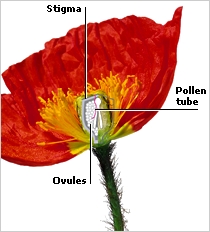
The female part of a flower has a special swelling, called a stigma. When pollen grains land on the stigma, they stick to it and begin to germinate. A microscopic tube sprouts from each pollen grain and starts to grow into the stigma. It then grows down through a stalk, called the style, towards the eggs in the ovules below. A flower’s stigma is held up on a style so it can catch pollen.
A flower’s egg is contained in a capsule called an ovule. The tip of the pollen tube penetrates the ovule, injecting the male sex cell. This fuses with the egg, fertilizing it. In flowering plants another male sex cell has to be injected before the ovule can become a seed. This second male cell fuses with nuclei, called polar nuclei, to form tissue that will make food for the baby plant, or embryo, as it develops inside the seed.
Most plants that use wind to disperse their pollen have separate male and female flowers. The male flowers, such as these catkins, produce huge quantities of pollen and usually hang from twigs or are held up on stalks where they can catch the wind. Most female wind-pollinated flowers have long syles with exposed stigmas that increase their chances of catching pollen.
The healthiest seeds are produced by cross-fertilization, using pollen and eggs from different individual plants. Plants have many ways of ensuring that this happens. In some species, male and female flowers are never produced at the same time on the same plant. In others, the sexes are separate. Holly trees are either male or female, for example. Only the female plants produce berries.

Unlike seedless plants, such as ferns, seed plants do not produce free-swimming sperm. Instead, their motionless male sex cell is completely enclosed by the tough casing of a pollen grain. Inside a pollen grain the male sex cell of a seed plant is protected from drying out. Instead of using water to swim to the egg, like the sperm of a seedless plant, it reaches the egg by being carried by the wind or animals.
When viewed through a microscope, many pollen grains have incredibly intricate surface structures. Some grains are spiky, possibly to help them stick to the stigma of the female part of the plant. Scientists are often able to tell the species of plant that has produced a sample of pollen just by looking at the shapes of the grains. Pollen grains are produced by most flowering plants in huge numbers. Despite their tiny size, they affect many people, giving them hay fever.
Many types of animals act as pollinators, transferring pollen between the anthers and stigmas of plants. Most plant species use insects as pollinators, since these flying animals are small enough to enter most flowers but can transfer pollen over large distances. However, some plants produce large flowers that are pollinated by animals such as birds or bats. Many plant species have flowers that are shaped in such a way that they can only be pollinated by a particular species of animal.
Different animal pollinators respond to different stimuli. Birds are attracted to the colour red but have a poor sense of smell, so many flowers pollinated by them are red but scentless. Insects are similarly attracted in different ways. Bees are drawn to blue or yellow, sweet-scented flowers. On the other hand, some flowers smell like rotting meat to attract flies.

Many flowers have patterns of lines on them. These guide insects towards the glands that produce nectar at the base of the petals. Some flowers display patterns in the ultraviolet light they reflect. Unlike us, the insects that pollinate these flowers have ultraviolet vision. These insects see the nectar guides, where we see plain-coloured petals.
