DK Science: Plastics
Plastics are used to make a wide range of materials, including furniture, computers, and toys. Plastics are not found in nature, but are created from the products of coal, oil, and natural gas. They are made up of carbon, hydrogen, and other atoms linked in long-chained molecules called POLYMERS. Plastics are so useful because they are strong, light and can withstand heat and chemicals better than many materials. They can also be moulded into practically any shape or size.
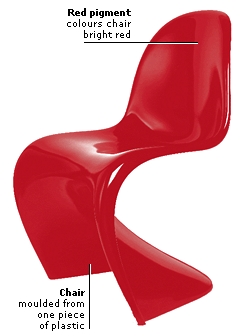
Plastics have revolutionized design, offering colours and shapes never available before. Plastic is liquid when first made and is then moulded or pushed into shape. Mixing dyes into the liquid creates translucent coloured plastics. Mixing in pigments creates opaque coloured plastics.
Modern plastics can be created with precise properties that suit a particular use. Mylar® is a plastic used to insulate space shuttles. It is a shiny, strong, and light polyester film made in very thin sheets. It reflects the intense heat generated when a space shuttle re-enters Earth’s atmosphere, protecting the craft and its crew.
Plastic bowls are often shaped by injection moulding. Plastic pellets are heated until they have melted. The liquid plastic is then pushed, or injected, into a mould, held in place by a clamp. After the plastic in the mould has cooled and hardened, the finished product is pushed out. This process is used to mass-produce items such as bowls, butter tubs, and yoghurt pots.
Polyvinylchloride, or PVC for short, is the plastic used to make credit cards and waterproof clothes. It is tough, flexible, cheap to produce, and easy to print on.
There are two types of polythene. Low-density polythene is used to make lightweight plastic bags. High-density polythene is stronger and is used to make plastic milk bottles.
Polystyrene can be either rigid or foamed. Rigid polystyrene is used to make toys and containers. Foamed polystyrene is used for fast food packaging.
Polyethylene terephthalate, more commonly called PET, is a strong plastic used to make fizzy drinks bottles. It can be recycled into carpets and ribbons for video cassettes.
Polypropylene, or PP, is a plastic with a relatively high melting point of 160°C (320°F). It is used to make camera film and dishwasher-proof plastic objects.
All plastics are synthetic polymers. Polymers are substances whose molecules are made of simpler molecules called monomers joined together in long, winding chains. The monomers contain carbon and hydrogen, and sometimes other elements such as oxygen and nitrogen. Synthetic polymers can be divided into two groups, thermoplastics and thermosets.