
DK Science: Machines
In science, a machine is any device that changes a force into a bigger or smaller force, or alters the direction in which a force acts. Machines come in all shapes and sizes. Large machines such as cranes, bulldozers, and tipper trucks are based on smaller, simpler machines called LEVERS , WHEELS , PULLEYS , SCREWS, and GEARS. Simple tools such as a spade, a knife, a drawing-pin, and a nutcracker are also machines.
Most levers are force multipliers. They reduce the effort needed to work against a force called the load. They magnify a small force into a larger force. When a force acts on an object that is fixed at one point, the object turns around this pivot point. The further away the force is from the pivot point, the easier it is to turn the object. That is how levers make work easier.
Levers can work in three ways. Class one and class two levers turn the effort into a larger force to work against the load. Class three levers work in the opposite way, to reduce the force and increase the control of it over a greater distance.
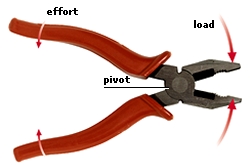
Pliers reduce the effort needed to grip something tight. The load and the effort are on opposite sides of the pivot. The load is greater than the effort.


A wheel and the axle it turns around combine as a machine that works like a lever. The distance between the rim of the wheel and the axle multiplies either speed and distance or force. If the effort is applied to the axle, the rim of the wheel turns further, and so faster, than the axle, but with less force. If the effort is applied to the rim of the wheel, the axle turns with more force but not so far or fast.

A steering wheel multiplies force because the rim turns further than the steering column. It multiplies your effort and turns the car’s wheels with more force than you actually apply. The road wheels multiply speed. The car’s engine turns the driveshaft and rear axle at a certain speed. The axle turns the large road wheels further and therefore faster.
A pulley is a rope looped around one or more wheels to make a heavy load easier to lift. The more ropes and wheels are used, the less force is needed to lift the load, but the further the rope has to be pulled. Pulleys make it easier to lift things using less force, but the same amount of work has to be done whether or not a pulley is used. Cranes lift huge weights using large pulleys.
Pulleys vary in usefulness, depending on the number of wheels and ropes they have. A simple pulley changes only the direction of a force. Doubling the wheels and ropes halves the force needed to lift a given weight, but the rope must be pulled twice as far.
A simple pulley has one wheel and one rope. It does not reduce the effort needed to lift a load, just the direction of the force. Using this simple pulley, it takes 10 newtons of force to lift a weight of 10 newtons.

A simple screw that holds pieces of wood together is also a type of machine. The spiral thread of a screw is designed to reduce the effort needed to drive it into a piece of wood. Turning a screw is like pushing something up a spiral ramp instead of trying to lift it straight up. It reduces the force needed, but that force has to be used over a greater distance and for a longer time.
When you turn the head of a screw, the long spiral groove down its side pulls the screw into the wood. Although you turn the screw head many times with a screwdriver, the screw moves forward into the wood only a short distance. However, the screw bites into the wood with a lot of force.
Gears are pairs of wheels with teeth around their edges that mesh and turn together. Gears are machines because they multiply turning force or speed. If one gear wheel drives another that has more teeth, the wheel with more teeth turns more slowly but with greater force than the other. If a gear wheel drives another with fewer teeth, the wheel with fewer teeth turns with less force but faster.

Different kinds of gears do different jobs. Spur gears multiply speed or force. Bevel gears change vertical movement into horizontal movement. Worm gears change the direction of horizontal movement. Rack and pinion gears change rotation into back-and-forth motion. Gears such as these can be used to transmit power to many different parts of a large machine.
