
DK Science: Energy
Scientists define energy as the ability to do work. Energy makes things happen. The energy in sunlight makes plants grow, the energy in food enables us to move and helps us to keep warm, and the energy in fuel powers engines. Energy comes in many different forms and can be converted from one form into another. The main types include POTENTIAL ENERGY , KINETIC ENERGY, and CHEMICAL ENERGY.
Energy that is stored up ready to be used in the future is called potential energy, because it has the potential (or ability) to do something useful later on. An object usually has potential energy because a force has moved it to a different position or changed it in some other way. When an object releases its stored potential energy, this energy is converted into energy of a different form.
When thunderclouds move through the sky, they build up a large amount of electricity inside themselves. This is known as static electricity, which is a store of energy. When a cloud builds up more static electricity than it can store, some of the electricity flows from the cloud to Earth in a bolt of lightning.
This type of potential energy powers bows and catapults. It takes effort to stretch a piece of elastic or rubber because the forces between its molecules try to resist being pulled apart. As the elastic stretches, the molecules move away from one another and gain potential energy. The energy stored in stretched elastic can also be used to power such things as toy cars and model aeroplanes.
A snowdrift on top of a mountain has a huge amount of potential energy. This is known as gravitational potential energy because it is gravity that is constantly trying to pull the snow down the mountain to the bottom. When an avalanche occurs, the snow gathers speed and its stored potential energy is turned into kinetic energy (the energy of movement).
Moving objects have a type of energy called kinetic energy. The more kinetic energy something has, the faster it moves. When objects slow down, their kinetic energy is converted into another type of energy, such as heat or sound. Objects at rest have no kinetic energy. Kinetic energy is often produced when objects release their potential energy.
A moving hammer has a lot of kinetic energy. As it strikes the nail, it slows down and loses its kinetic energy. The energy does not disappear, however. Some of it goes to split the wood to make way for the nail, some passes into the wood as heat energy, and some is converted into sound.
This is the energy involved in chemical reactions, when elements join together into compounds. This energy is stored inside the compounds as chemical potential energy. The stored energy can be released by further chemical reactions. The food we eat stores energy that is released by digestion. Energy can also be released by burning the chemicals in a process called combustion. Fuels are chemical compounds that release heat energy by combustion.
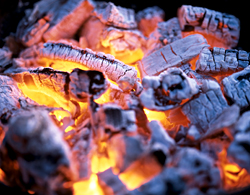
Fuels such as charcoal are hydrocarbons, chemical compounds made mainly from hydrogen and carbon. When a fuel burns in air, the hydrocarbons break up into simpler compounds. The chemical potential energy they contain is then released as heat energy. Light energy is produced at the same time and this is what makes a fire glow as it burns.
When humans or other animals eat food, they use its stored energy to keep warm, maintain and repair their bodies, and move about. Different types of food store different amounts of energy. The amount of energy a food contains is measured in kilocalories (called Calories for short).

