
DK Science: Atmosphere
The Earth would be as lifeless as the Moon without the atmosphere – a blanket of gases surrounding the planet and extending about 700 km (430 miles) above its surface. This relatively thin layer, held in place by gravity, provides us with oxygen to breathe and separates us from the void of space. It includes the OZONE LAYER, which screens out harmful solar radiation. PRESSURE SYSTEMS in the atmosphere affect the Earth’s weather.
Auroras are shimmering curtains of light seen at night in the polar regions. They are known as the Northern Lights in the Arctic, and as the Southern Lights in the Antarctic. These spectacular displays are caused by charged particles from the Sun striking the upper atmosphere above the poles.
The troposphere is the lowest layer of the atmosphere and contains 75 per cent of all its gases. Above is the stratosphere, which includes the ozone layer. Higher still is the thin air of the mesosphere, where meteors burn up. The thermosphere contains an electrically charged layer that radio waves bounce off. The exosphere is the top layer, fading off into space.
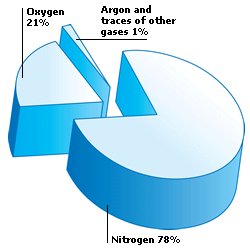
Just two gases, nitrogen and oxygen, make up 99 per cent of the mixture of gases in the atmosphere. Nitrogen contributes 78 per cent and oxygen 21 per cent. The last 1 per cent is mainly argon (0.93 per cent), plus 0.03 per cent carbon dioxide and traces of other gases, including helium, neon, ozone, methane, and hydrogen.
Ozone is a form of oxygen that gathers in the stratosphere to form a layer. This layer screens out harmful ultraviolet (UV) rays from the Sun, which can cause skin cancer. In the 1980s, scientists discovered that thin areas, or holes, were appearing in the ozone layer over the polar regions each spring. Ozone loss is caused by chemicals called chlorofluorocarbons (CFCs).
Pressure systems in the atmosphere are masses of moving air that create winds and the weather. The air is set in motion by changes in temperature and air pressure (the pushing force of air from all directions). Air pressure is greatest at sea level, because there is a larger weight of air pushing down. The higher in the atmosphere you go, the less air and air pressure there is.
Air pressure is measured in units called millibars (mb), using an instrument called an aneroid barometer. Behind the barometer’s dial is a chamber from which some air has been removed. Changes in air pressure cause the air in the chamber to expand or shrink, and this moves the needle around the dial.
Warm air is lighter than cool air, so it rises above it. Rising warm air creates low-pressure areas called cyclones, or lows. Sinking cool air forms high-pressure anticyclones, or highs. Air moves from higher to lower pressure, bringing different weather systems. Highs usually bring dry, fine weather, and lows bring rain.
Torricelli discovered air pressure in the 1640s. He made the first barometer by upending a glass tube filled with mercury (a heavy liquid metal) in a bowl. The mercury remained in the tube near the closed top to a height of 76 cm (30 in). Torricelli concluded that air pressure prevented the liquid from falling further.
