
DK Science & Technology: Nanotechnology
A nanometer is one billionth of a meter. This is about a million times smaller than the period on this line. Nanotechnology aims to make tiny machines measured in nanometers.
A nanomachine is built from individual atoms, like the parts of a tiny construction kit, with atomic wheels and motors. A nanomachine will make other products from atoms, such as nanovehicles to transport drugs through the body’s blood stream. Vast armies of nanomachines might even assemble CARBON COMPUTERS atom by atom.
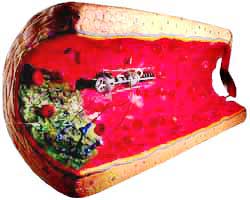
Nanomachines will be designed to build and copy themselves. They will be self-assembling in a way similar to the molecules that make up living things. To build a large structure, such as a car, billions of nanomachines will be organized to work together.
One danger is that self-assembling nanomachines could multiply and spread out of control, damaging natural materials. They would have to be programmed so that they could not escape into the environment in this destructive way.
At an atomic scale, scientists think carbon will have better electrical properties than silicon for making computers. A computer processor could be made by linking individual carbon atoms. Only nanomachines could work at this scale.
Nanomachines could make things, such as carbon cars, by linking carbon atoms one at a time into the diamond structure. These new cars will be many times stronger, yet lighter, than existing versions made with titanium, aluminum, and steel. A carbon car built by nanomachines would be light enough to lift with one hand.
