
DK Society & Beliefs: Economy
People work together to grow things, extract raw materials from the Earth, manufacture objects that are sold to CONSUMERS, and help to organize our lives through services like banking. The PRODUCTION and distribution of all these things make up the economy.
In an economy, there are people who supply goods and services at a cost, and people who demand those goods and services and pay for them. The laws of supply and demand set prices. If there is a lot of demand, the prices increase. If the supply of goods is high, the prices go down. If the price drops too low, the manufacturers may reduce the supply.
In economics, the market is a place, or a network, where buyers and sellers exchange goods and services for money. All activity in the market depends on the supply of, and demand for, these goods and services.
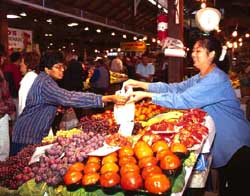
In traditional economies, people produce the goods they need on a small scale, and sell the surplus (what they do not need) at local trading centers, or markets. In command economies, all economic activity is controlled by the government rather than private companies or market forces. In a mixed economy, some industries are privately owned by companies and others, such as public transportation, are publicly owned and run by the government.
Domestic work, such as housework, is not considered part of the economy, unless someone is paid to do it. The portion of a nation’s income that is (illegally) not declared for tax is called the black economy.
Production involves the use of Earth’s raw materials and human labor to make useful things. Every society uses its land, people, skills, and tools to make products, from gasoline to stainless steel and running shoes. In modern economies, companies aim to maximize profits by keeping their production costs down and their sales up.
An economy grows when its production increases in quantity. Growth in the economy can lead to more jobs and more income for consumers to spend. It also frees resources for other uses, such as science, the arts, or sports. However, economic growth can also create difficulties, such as environmental problems and the gap between rich and poor.
Someone who buys goods and services is called a consumer. Most people are consumers, because they need to buy basic goods, such as food, shelter, and clothing, in order to live. Producers need to predict what consumers want, so that they can make goods that will sell.
Consumers need a way to pay for goods before they can decide which goods to buy. Their buying power comes from income (wages earned by working) or investment (profits made from owning stocks or property). A wide choice of products gives consumers some power over producers, since a company will go out of business if consumers do not buy its product.
Consumer goods are products manufactured to satisfy personal needs. Goods that are required for the production of other goods and services, such as paper or coal, are known as producer or capital goods. Consumer goods can include anything from clothing and CDs to children’s toys and Coca-Cola™. Demand for consumer goods is often created by advertising and by technological changes.
