
DK People & Places: Eastern Asia
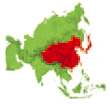
The harsh landscapes of Eastern Asia include remote mountains, cold deserts, and the vast, dry grasslands of Mongolia and northern China. In southeastern China, there are wide plains and valleys, watered by mighty rivers. North and South Korea form a peninsula, where the land is mountainous and thickly forested, as are the neighboring islands across the sea that make up Japan.
The wall stretches over 3,980 miles (6,400 km) through the mountains and deserts of northern China. It is the longest structure ever built by hand. Work began over 2,200 years ago by order of the first Chinese emperor, Qin Shi Huangdi. Most of the wall was built by slaves in the 15th century to keep out Mongolian invaders.
Hong Kong was returned to China in 1997, having been a British colony for 99 years. With a population of over 6.5 million people, this small territory lies in southeast China and comprises a mountainous mainland area and 236 offshore islands.
About 80 percent of China’s vast population lives in small, rural villages, and works on the land. The rest live in overcrowded cities, where housing is scarce. With the world’s largest population, China has a huge task to provide all its citizens with food and education.
International trade is transforming the east coast port of Shanghai, China’s largest city. Home to more than nine million people, Shanghai is a leading industrial and commercial center with a busy harbor. Its modern skyline is crowded with high-rise office buildings, convention centers, and modern shopping malls.
The mountainous islands of Japan have limited farmland, so the people depend on the sea for food. The fishing fleet, which is the largest in the world, catches about 6 million tons of fish each year. Fresh fish forms the basis of most Japanese cooking, and much of it is eaten raw.
Unlike most deserts, the Gobi Desert in Mongolia has hot summers, but icy winters. The Bactrian camels that live in the Gobi have adapted by growing thick winter coats that molt in the spring. The desert, the fourth largest in the world, is made of rock and sand. It is famous for the discovery of fossilized bones and eggs of dinosaurs that lived here 85 million years ago.
Rice is the staple food of eastern Asia, and the region’s farms must produce enough to feed the vast populations. The fertile, flooded rice fields of southern China produce two harvests every year. Planting and harvesting are still done by hand, and water buffalo or oxen pull farm machinery. In contrast, rice is intensively farmed in Japan with modern machinery.
Korea was a single country until the end of World War II, when it was occupied by Russian and American forces. In 1948, it was divided in two and democratic South Korea separated from its communist neighbor. Hostilities between these countries led to the Korean War (1950–53). Today, South Korea specializes in producing and exporting manufactured goods. North Korea remains a politically isolated regime.
Capital city: Beijing
Area: 3,705,386 sq miles (9,596,960 sq km)
Population: 1.3 billion
Official language: Mandarin Chinese
Major religion: Majority are nonreligious
Currency: Renminbi (called yuan)
Capital city: Ulan Bator
Area: 604,247 sq miles (1,565,000 sq km)
Population: 2.6 million
Official language: Khalkha Mongolian
Major religion: Tibetan Buddhist
Currency: Tugrik
Capital city: Pyongyang
Area: 46,540 sq miles (120,540 sq km)
Population: 22.6 million
Official language: Korean
Major religion: Atheist
Currency: North Korean won
Capital city: Seoul
Area: 38,023 sq miles (98,480 sq km)
Population: 47.4 million
Official language: Korean
Major religions: Mahayana Buddhist and Protestant
Currency: South Korean won
Capital city: Taipei
Area: 13,892 sq miles (35,980 sq km)
Population: 22.5 million
Official language: Mandarin Chinese
Major religion: Buddhist
Currency: Taiwan dollar
