
Movies and Film: The Master: The Art of Akira Kurosawa
The Master: The Art of Akira Kurosawa
In 1951, a virtually unknown director from Japan stunned the cinematic world when his Rashomon, the heavily allegorical story of a nobleman caught in a psychological struggle over the nature of truth itself, garnered top awards at the Venice Film Festival and won an Oscar for best foreign film. Since that illustrious moment, Akira Kurosawa has ranked in the forefront among world directors.
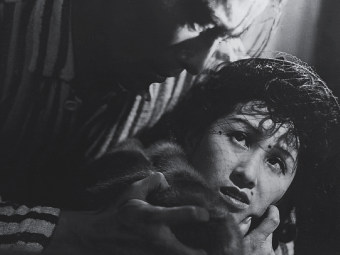
The tragically beautiful Takashi Shimura in Akira Kurosawa's Drunken Angel (1948).
For more than 50 years, from his first feature Judo Saga (1943) to 1993's Madadayo and beyond, Kurosawa crafted an utterly unique style that combines elements of traditional Japanese theater (Noh drama and kabuki, for example) with an unparalleled sensitivity to the global reach of human dramas. His seemingly fearless willingness to tackle any theme, genre, or setting distinguishes him as one of the most inventive directors of the twentieth century.
Among Kurosawa's many must-see films, three that he made after Rashomon truly stand out. Seven Samurai (1954) starred Toshiro Mifune in his most enduring role as the leader of a band of traditional Japanese warriors defending a village against marauders. Ran (1985) is an award-winning adaptation of Shakespeare's King Lear that brings out some surprising and generally unacknowledged themes in the Bard of Avon's story of a flawed father and his three daughters. And Dersu Uzala (1975), most of which he shot in the Soviet Union, won the Oscar for best foreign picture and other prestigious international awards.
Kurosawa's most enduring legacy may be the opening of Asian cinema as a whole to Western audiences. While some of his best pictures remain relatively unknown to all but film specialists and junkies, his cultural ambassadorship gave world cinema one of its most vital modes of artistic exchange between east and west.
Short Cuts
Hollywood's classic Western The Magnificent Seven (1960), directed by John Sturges, was a direct adaptation of Kurosawa's Seven Samurai (1954), which was itself alternatively titled The Magnificent Seven.
How to Watch a Kurosawa Film
Though visually arresting, Kurosawa's films can sometimes feel a bit slow, laden as they are with often heavy symbolism and long gaps between significant points in the narrative. But these are precisely the qualities that make his pictures so unique, and it would be a mistake to fast forward to get to the next sword fight. Here are four simple attributes of many Kurosawa films that you'll need to remember if you want to learn how to appreciate these modern filmic masterpieces. If you watch for them carefully, you'll get much more out of these pictures than you would otherwise.
- The art of repetition. Kurosawa will often repeat discrete narrative elements in his films in order to highlight the dynamic nature of specific events or the cyclical nature of life. In Seven Samurai, a village is repeatedly attacked by bandits and valiantly defended by noble warriors; Rashomon narrates an attack upon a nobleman by a bandit four different times from four contrasting perspectives.
- The significant pause. Though deceptively simple in terms of technique, long narrative pauses are a staple of Kurosawa films, encouraging viewers to reflect on what has come before in order to better understand what will follow. When you come to such a pause (say, the long gaps between attacks in Seven Samurai, or the lingering shots of landscapes in Akira Kurosawa's Dreams [1990]), consider its impact upon the sequential progression of the film. How would the texture of the story change if he had moved straight on to the next narrative event?
- Occidental motifs. Though long revered for giving native Japanese film unprecedented international recognition, Kurosawa was virtually obsessed by American and European film, drama, and literature. Before watching Throne of Blood (1957), be sure to reread Shakespeare's Macbeth, of which Throne is a brilliant adaptation; in a similar vein, brush up on your King Lear before renting Ran. The films of John Ford were a particular inspiration for Kurosawa, who may have based The Hidden Fortress (1959) upon some of the American director's greatest Westerns.
- Humanism. Kurosawa's film oeuvre is unified by the director's deep-seated belief in the fundamental goodness and dignity of the human being. Though his protagonists are often caught in seemingly impossible situations struggling against seemingly insurmountable odds (as in Seven Samurai and Dersu Uzala), the old-fashioned notion of the "human spirit" generally triumphs in Kuro-sawa's films, providing a narrative goal that informs a surprising number of his works.
The films of Akira Kurosawa join a deep sense of tradition with a commitment to artistic innovation—a combination that characterizes much of the best filmmaking in the Far East during the past 20 years.
Excerpted from The Complete Idiot's Guide to Movies and Film © 2001 by Mark Winokur and Bruce Holsinger. All rights reserved including the right of reproduction in whole or in part in any form. Used by arrangement with Alpha Books, a member of Penguin Group (USA) Inc.
To order the e-book book direct from the publisher, visit the Penguin USA website. You can also purchase this book at Amazon.com.
Trending
Here are the facts and trivia that people are buzzing about.




