New York

New York State Information
Official Name: State of New York
Organized as a territory: 1624
Entered Union (rank): July 26, 1788 (11th state)
Present constitution adopted: 1777
State abbreviation/Postal code: N.Y./NY
State Area Code: 718
Nickname: The Empire State
Origin of name: In honor of the Duke of York
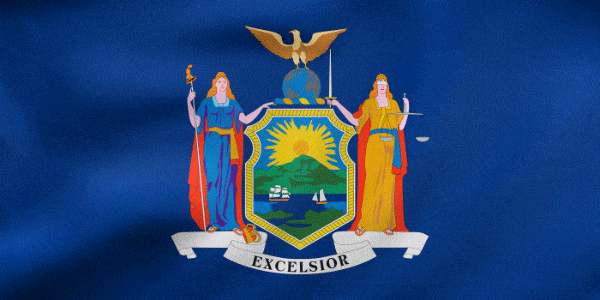
Motto: “Excelsior (English: ever upward)”
Slogan: "I Love New York"
| Animal | Beaver (1975) |
| Fish | Brook trout (1975) |
| Gem | Garnet (1969) |
| Flower | Rose (1955) |
| Tree | Sugar maple (1956) |
| Bird | Bluebird (1970) |
| Insect | Ladybug (1989) |
| Song | "I Love New York" (1980) |
Government
Governor: Kathy Hochul (August 2025)
Lieut. Governor: Antonio Delgado (August 2025)
Secy. of State: Robert J. Rodriguez (appointed by the governor)
General Treasurer: Thomas DiNapoli (serving an unexpired term)
Atty. General: Letitia James (to November 2026)
Senators: Chuck Schumer, D (to January 2025); Kirsten Gillibrand, D (to January 2025)
Historical biographies of Congressional members
Population
Residents: New Yorker
Resident population: 19,680,000 (Fourth largest state, 2022)
10 largest cities (Year): New York, 8,468,000; Brooklyn, 2,577,000; Queens, 2,271,000; Manhattan, 1,629,000; Bronx, 1,427,000; Staten Island, 475,000; Buffalo, 276,807; North Hempstead, 231,117; Rochester, 210,606; Yonkers, 209,530
Race/Ethnicity: White (52.2%); Black (14.8%); Hispanic/Latinx (19.5%); Asian (9.5%); Native American (0.7%); Pacific Islander (0.1%)
Religion: Catholic (31%); Protestant (26%); Non-Religious (27%); Jewish (7%); Other Christian (3%); Muslim (2%); Buddhist (1%); Hindu (1%); Other (1%); Unknown (1%)
Sex: Female (51.8%); Male (48.2%)
Age: Under 18 (24.7%); 18-64 (62.4%); 65 and over (12.9%). Median Age: 39
Economy
GDP: $1,853 billion dollars (3rd in U.S., 2021)
Unemployment: 4.3% (2022)
Geography
Land area: 54,555 sq mi. 141,297 km2
Geographic center: In Onondaga County, 2 miles SouthWest of Manlius
Number of counties: 62
Largest county by population and area: Brooklyn, 2,736,000 (2021); St. Lawrence, 2,686 sq miles
State parks/recreation areas: 176
See more on New York:
Encyclopedia: New York
Encyclopedia: Geography
Encyclopedia: Economy
Encyclopedia: Government
Encyclopedia: History
Monthly Temperature Extremes
New York State is the 11th oldest state in the USA after being incorporated into the Union in 1798 from its old title of the Crown Colony of New York. Since that period, New York has only ever grown in importance and stature not only in the USA but also across the world.
Thanks to the most famous city in the state, New York City (NYC), it is the fourth most populous state and one of the most economically prosperous. As a major site of immigration during the 19th and 20th centuries, its population grew rapidly leading to extensive commercial growth and the creation of a cultural melting pot that persists to this day.
The rest of the state is made up of mostly wilderness areas and national parks, including a border with Lake Ontario. From humble beginnings with Fort Nassau, the first Dutch settlement in North America, to the world-famous state it is today, New York is a highly important state to modern America.
New York State Geography
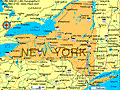
New York is the 27th largest state by area, placing it between Iowas and North Carolina. It is located in the northeast of the country, directly north of Pennsylvania and west of Vermont. On its northern border is Canada and a stretch of Lake Ontario. It also borders Massachusetts and Connecticut in the east. It has five major cities, including Albany, the state capital, and the most notable city, New York City which is the most populous city in America. Other cities include Buffalo, Rochester, and Syracuse.
In contrast to the densely urban nature of New York City, the rest of the state is mostly made up of rural meadows, forests, and mountains. There are three mountain ranges either fully or partially in New York; the Appalachians, Catskill, and Adirondack. The highest point amongst these and therefore the state is Mount Marcy, in the Adirondacks, with an elevation of 5,344 feet. This contrasts greatly with the lowest point which is situated along the coastlines and New York City.
The Hudson Valley is a major river valley in the state and drains to the Hudson River, which flows into the Atlantic Ocean at New York City. There is a northern border with two of the Great Lakes: Lake Erie and Lake Ontario. The Finger Lakes, a collective term for 11 grouped lakes in the west of the state, feature as the other prominent lakes in New York. Major beaches include Jones Beach in Long Island and multiple beaches in the affluent area of The Hamptons.
In general, the climate in New York is classed as humid continental which is comparable to Eastern Europe and parts of southern Russia. The state experiences hot summers and often long, cold winters with New York City famous for its snowy cityscape around December and January. There are abundant plant species such as American Ginseng and Cow Parsnip which support a diverse range of mammals, birds, and insects. Mammals include the American Black Bear, Bobcat, and Moose with many bird species such as Great Horned Owls and Canada Geese. The Hudson Estuary is a productive ecosystem that is famous for its oysters and clams.
New York State People & Population
New York’s average age of 39 is in line with the national average with 62.4% of the state’s population coming into the 18-64 age bracket. The under-18s outnumber the over-65s by 2 to 1 and, therefore, New York will see a slightly rising population over the coming decade. 51.8% of the population in New York are females meaning 48.2% are male which, again, is consistent with the national average.
52.2% of people in New York are white, making them the ethnic majority, with the next largest group being Hispanic/Latinx at 19.5%. Black ethnicities make up 14.8%, Asian 9.5%, Native American 0.7%, and Pacific Islander 0.1%. Native Americans are now the second lowest ethnic group by number but were the original inhabitants of the land New York sits on before 1600.
The main religion in New York is Christianity, with Catholicism making up the largest of the denominations. Following that, most people are Non-Religious at 27% mainly due to a young population of millennials in New York City. 7% are Jewish with Muslim at 2% and Buddhist and Hindu at 1% respectively. Immigrants make up 23% of the population which is high compared to most states in the USA with other high immigration levels existing in California and New Jersey.
New York State Government
The New York Constitution, signed in 1777, dictates the governmental structure of the state. There are three main branches of government: judicial, legislative, and executive.
Legislative departments have the authority to make laws on behalf of a political entity, judicial departments enforce the law via the courts and executive branches are responsible for the wholesale governance of the state.
The governor, who is elected by the public usually every four years, is in charge of the executive branch and has the power to approve or veto legislation put forward by the legislature. They are deputized by a lieutenant governor. The state also has an attorney general who advises the governor on legal matters. The legislative department is split into a lower and upper house, both of which are elected on two-year cycles.
At a federal level, the state is represented by two senators who have historically almost always been part of the Democratic Party. New York has 29 votes in the electoral college, the group that votes for the President on behalf of their populace, which used to be far higher at 47 in 1953. Many of its towns are Democratic Party strongholds however more rural areas are Republican-leaning. The state is also internationally important as part of global governance due to the fact that the United Nations is headquartered there.
New York State Economy
New York has an extremely healthy economy in general, with a GDP in Q2 of 2022 of $2 trillion. This would make it the 11th largest economy in the world if it were a sovereign nation. It also has the highest GDP per capita in the country at $105,226 in the third quarter of 2022. However, significant poverty still exists, especially in lesser towns outside of New York City which skews the average significantly.
New York ranks 21st in the USA for quality of life, despite its high GDP per capita. This is mainly down to extremely high living costs, especially in housing and healthcare, forcing more people into homelessness and a lack of job opportunities for those possessing lower education levels.
New York’s economy has transitioned almost entirely away from primary forms of employment and towards tertiary and quaternary sectors. A large chunk of its economy is made up of the finance sector, primarily focused around the historic site of Wall Street. It is the financial center of the state and arguably the entire country, home to the New York Stock exchange and Nasdaq just a few streets away. They are the two largest stock exchanges in the world.
There is also a high concentration of technology development and manufacturing in the state, mostly concentrated around Flatiron Square in Manhattan known as "Silicon Alley". Long Island has also become a significant focal area for STEM companies, most notably in biotechnology research.
New York State Interesting Facts
New York State’s reputation is dominated by the globally famous New York City. As such, most of the state's cultural features are associated with the city and its natural features upstate take a back seat. The city is a nexus for the arts industries in relation to theater, film, and fashion where New York Fashion Week represents a major event in the calendar of the latter. Additionally, it is a hub for tourism in the country and also is home to the most famous sports teams in the world. Outside of the city, New York is known for its shores on Lake Ontario which borders Niagara Falls and Saratoga Springs for its horse racing venue.
Broadway
New York’s most famous cultural export is Broadway, a road in New York City’s Manhattan where musicals and plays are performed in large theaters. Last year, as it recovered from a reduction in audience numbers due to the coronavirus pandemic’s infringement on in-person performances, Broadway as a whole grossed $1.9 billion, providing a huge revenue for the city. It attracts tourists from around the world who come to see shows that are often never displayed elsewhere. Historically, the road was a path beaten out of the bush by indigenous people which was then widened by Dutch colonists. The first theater, the Lyceum, opened on the street in 1735 and still operates today.
Recent popular shows include "Hamilton", "The Book of Mormon", and "Six: The Musical". It is often the launchpad for major acting careers such as Meryl Streep and Morgan Freeman as well as famous directors like Stephen Sondheim. The productions on Broadway are recognized yearly with many winning prestigious Tony Awards. Shows also tour globally and are often transferred to the West End in London.
NYC Architecture
The state is also famous for its status as an architectural trailblazer, especially in the early 20th century. In 1800, the city had a population of 60,000 but by 1900 it had soared to 3.4 million. With this came significant urbanization and an increase in demand for housing but also business premises. With a relatively small surface area to build on compared to other cities like Los Angeles, New York maximized its space by building vertically rather than laterally. This popularized skyscrapers as a form of building which was also being adopted in Chicago.
These new buildings brought with them the chance to express some unique design aesthetics. New York’s first skyscraper aptly nicknamed the "Tower Building" was built in 1889 and ever since the skyscraper has been a signature of the city.
The Chrysler Building was constructed in 1930 and was the first building to top 1,000 ft. Its distinctive art deco style was striking amongst the rest of the skyline and became symbolic of New York’s prosperity and booming social scene. It was overtaken as the tallest building in the world a year later by the Empire State Building which now stands as a major icon of the state.
The Statue of Liberty, donated to the USA by France in 1881, is another famous architectural landmark that appears on much of the city’s merchandise. As expressions of an art form, New York’s buildings document a timeline of architecture through the ages and attract millions of tourists each year.
Sports Teams
Aside from the arts and creativity, New York is home to some of the largest and most famous sports franchises in the world. The most well-known team is the New York Yankees, a Major League Baseball side that plays their home games at the Yankee Stadium in the Bronx. Over the 20th century, they were hugely successful, amassing 27 World Series titles which is the most of any team in the country. They are arguably the most successful sports franchise in America and perhaps the world. Their team logo is iconic, appearing on clothing garments, especially baseball caps, across the globe.
In American Football, the New York Giants exist as the longest-established team in the northeastern U.S., winning eight NFL titles to make them the third most successful team of all time. Their merchandise and branding have been a global phenomenon and fans come from around the world to see them play at MetLife Stadium. In basketball, the New York Knicks are the most well-known and are one of only two teams to still play in the city they were first established. They have won two NBA championships in their history but are more well-known for their passionate fanbase and famous home arena Madison Square Gardens.
New York State History
In relation to the rest of the U.S., New York has quite an extensive and important history. It played a major role in the American Civil War as both a battleground and a leading seat of rebellion. After this, it was also central to the writing of the Constitution and became a driving force behind the nation’s early economic growth. It was also highly influential in the Civil War as the most populous in the Union. Its large share of well-known political personnel and newspapers meant it could shape national sentiments. Following the Civil War, New York has remained a prominent state in all facets of American life to the present day.
Pre-Colonial History
Like all of what is now modern-day America, pre-1600 New York was inhabited by Native American tribes. Humans are first recorded to have been present in the area 9,000 years ago. It is thought they then abandoned the area due to a warming climate leading to the decline of big game in the area. Then, 3,000 years ago, humans returned and settled permanently, leading to the Native American tribes that would later form.
The Iroquois and Algonquian tribes were dominant across much of the state with the Lenape people controlling what is now New York Harbor. The Lenape were extensive and well-versed farmers by the time Dutch settlers made contact It is estimated that around 15,000 Lenape members lived there by 1600 A.D.
The tribes lived in relative peace compared to what was to come with a colonial settlement, but there were regular conflicts between tribes for land and possessions. Early contact with Europeans was fleeting and was first documented by Giovanni da Verrazzano, an Italian explorer, in 1524 when native people met him on boats in New York Harbor. Verrazzano named it New Angouleme but his stay was short due to a storm. French trades also built a small chateau in the state in 1540 but this also did not last more than a year.
Colonial History
Proper colonization of the area did not happen until the early 1600s when Henry Hudson explored the area on behalf of the Dutch East India Company. News of his discoveries of a native population was enough to entice other Dutch traders with the prospect of fur trading.
As a result, more Dutch settlers began making the journey to the state and set up the first trade post on Manhattan Island in 1613. Dutch settlers also rebuilt the French chateau as Fort Nassau along the Hudson River near present-day Albany, establishing a more permanent presence in the area. Fort Amsterdam was built in 1624 in Lower Manhattan to give the Dutch a base of operations which later became New York City.
Dutch traders exploited the Native Americans' reliance on animal pelts as a form of economy which eventually led them to exhaust local wildlife populations. This led to a reliance on the Dutch for sustenance and a large reduction in native populations over the 17th century due to starvation, migration, and disease.
Dutch influence expanded along the Hudson into modern-day Poughkeepsie and also south into what is now New Jersey. They named it New Netherlands. Towards the end of Dutch control, different conflicts broke out between Native Americans and the Dutch leading to massacres of native people.
In 1664, British ships entered Gravesend Bay near Brooklyn and took Dutch settlements with little resistance. In the same year, the Dutch quickly surrendered all control over the area and left, returning to Europe. British settlers renamed New Netherlands as New York after the Duke of York in 1664. This began the period of New York’s history where it was known as the Crown Colony of New York. Slavery was being practiced at this time in the area as it underwent a rapid expansion. Farming developed significantly in upstate New York, feeding the growth of the population in the city from 8,000 in 1664 to 167,000 in 1771.
In 1765, the British introduced the Stamp Tax, requiring all colonies to print on officially stamped paper made in London. It is considered one of the long-term causes of the American War of Independence as it gave rise to organized opposition groups such as the Sons of Liberty in New York. They were the most nationally prominent rebel group and leaders of rising anti-British sentiment in the country.
After the Battles of Concord and Lexington in 1775 made compromise impossible, the War began. New York was the strategic Lynchpin of Britain’s campaign due to its port and remained their base of operations throughout. The State was also host to the turning point of the War, where Revolutionaries defeated a British force in the Battle of Saratoga in 1777. In all, New York saw around one-third of all the battles in the Revolutionary War.
Upon the War’s end, New York became the first national capital of America and remained that way until 1790 when it transferred to Virginia. They ratified the U.S. Constitution in 1788 and saw the inauguration of George Washington and the first U.S. Senate. Although it wasn’t a southern state, New York has a long history of slavery and at one point had the second-highest slave population in the country. It was not until 1817 that they agreed to abolish slavery, enacting the process in 1827.
Pre-Civil War History
After the Civil War, Alexander Hamilton, a prominent New York revolutionary leader, became central to the formation of the USA’s governance. He argued for a national federalist government that would see one body oversee the wider governance of individual states. He published his arguments in New York newspapers and eventually won the decision in his favor after a compromise with Thomas Jefferson. In this sense, New York was key to the formation of modern America.
In the years of relative peace between the Revolution and the Civil War, New York prospered and saw rapid developments in transport infrastructure.
In 1807, Robert Fulton created the first successful steamboat line in the country, ferrying from New York to Albany. 1825 saw the opening of the Erie Canal which connects New York to Lake Eerie (and therefore Canada and inland states) and solidified New York as a major trading hub. By this time, New York’s state borders had settled and approximately match those of today. One of the earliest steam railroads was also built in New York in 1831 as the Hudson-Mohawk Railroad.
Western cities such as Buffalo became hotspots for more liberal social values in the mid-1800s, including growing support for abolitionism. As part of this, the Underground Railroad operated in the area as a destination for freed slaves. In the 1840s, various laws were enacted to increase rights for slaves such as protecting them from southern slave catchers. Education was also made more accessible although often in segregated settings. It also emerged at this time as having one of the largest concentrations of free African-Americans in the country.
Culture also boomed before the Civil War. Writers such as Washington Irving wrote classics like "Rip Van Winkle" and "The Legend of Sleepy Hollow" in the state and the New York Knickerbockers formed as the state’s first baseball team. Due to the state’s history with baseball, the National Hall of Fame was chosen to be located in Cooperstown. Wine production continued from its colonial period and the state is now home to one of America’s oldest wineries in the Hudson Valley.
New York had a relatively low profile in the civil war. No battles were fought in the state’s territories although more soldiers from New York fought in the war than any other unionist state, including 27,000 in the Battle of Gettysburg. War was inconvenient for the state as it had heavy trade links to the Deep South and the city had a large minority of Democratic supporters who strongly opposed Abraham Lincoln. Nonetheless, New York voters elected Lincoln in the 1860 election thus confirming their support for the Union in the Civil War.
Post-Civil War History
After the Civil War, New York solidified itself as a major financial hub in America and the world. Immigration from Europe continued to rise, especially from Ireland and Germany with the opening of Ellis Island in 1892.
By 1925, New York City’s population outgrew that of London, therefore becoming the most populous city in the world. Alongside this population boom came a rapid period of urbanization, which saw the skyscraper become the unofficial emblem of the state. Theodore Roosevelt was governor of the state in the late 1890s, pursuing a package of progressivism that sought to democratize society. It led eventually to a referendum on women’s suffrage in 1917 which successfully passed although not without opposition.
New York also became a center of the Roaring Twenties; a period of immense prosperity, unique developments in music and fashion, and a generally optimistic social atmosphere in the 1920s. New York also hosted the Winter Olympics at Lake Placid in 1932. However, this era of optimism was soon ended by the Great Depression which occurred in 1929.
The Depression was a decade-long period of extensive economic decline for the country as a whole and immense poverty for millions of citizens. It began in New York with the Wall Street crash when investors lost confidence in the stock markets and a mass sale of stock was initiated, known as Black Tuesday. Billions were lost in mere hours and the country would not fully recover until the mid-1950s. This was the direct prelude to the Second World War.
Modern History
During World War II, New York supplied more equipment than any other state at 11% whilst the state saw 32,000 casualties. The war’s main domestic impact on New York was twofold. First of all, it transformed social attitudes toward discrimination.
As the state needed labor forces to produce supplies, employment laws were altered to outlaw discrimination in the workplace, meaning women and minority workers could gain employment more easily. Secondly, it saw the final industrial period of New York. After the war, manufacturing greatly decreased in favor of a service economy. The middle classes began to rise as service jobs became more common and neighborhoods like Long Island became more affluent suburbs.
In the 1970s, the state’s population declined for the first time on record, mostly due to the change in economic structures. In the 1980s, New York gained a reputation for being high in crime and more dangerous than other cities, thanks in part to the crack cocaine epidemic that lasted into the 1990s. Around this time, New York saw a rapid transformation in its culture as rap and hip-hop became hugely popular forms of music both at the state level and nationally.
New York in the 1980s and 1990s was the center of a new cultural revolution that drove immigration to New York City once more, leading to a rising population. It was a relatively progressive state too, which meant the LGBTQIA+ community grew substantially and became a vibrant source of creative expression.
The turn of the millennium in 2000 was an optimistic time for New York, especially the city. However, the 2001 9/11 terrorist attacks on The World Trade Center, which killed almost 3,000 people, altered both the city’s trajectory and the country’s as a whole. Investment and jobs temporarily left the city and a brief period of economic decline ensued. Although there was a period of togetherness following the attack, there was a shift in optimism in response to what was such a violent attack. A monument now rests at Ground Zero, the former site of The World Trade Center.
The city recovered from the attacks within a few years and didn’t experience any major events until 2012 when Hurricane Sandy hit the state. Extremely high winds devastated coastal areas such as Long Island and storm surges flooded the many low-lying areas of New York City. The hurricane had a huge impact on many small business owners and there are constant talks over how to better protect the area against the threat of rising sea levels due to climate change.
New York City saw some of the highest infection rates during the Coronavirus pandemic of 2020. In March 2020, the city had the highest number of cases across the country. Nonetheless, as with many other instances, the state emerged once more in 2021 and returned to the cultural hotspot that it has been for centuries.
New York State and Beyond
New York is one of the most important states in the history of America, and we hope that you found out all you need to know about The Empire State with our handy breakdown. If you’ve enjoyed learning about how New York was molded into the state it is today, then why not read up on the American Revolution?
Selected famous natives and residents:
- Kareem Abdul-Jabbar basketball player;
- Lucille Ball actress;
- Humphrey Bogart actor;
- James Cagney actor;
- Maria Callas opera singer;
- Benjamin N. Cardozo jurist;
- Paddy Chayefsky playwright;
- Peter Cooper industrialist and philanthropist;
- Aaron Copland composer;
- Tom Cruise actor;
- Sammy Davis, Jr. actor and singer;
- Agnes de Mille choreographer;
- Eamon De Valera president of Ireland;
- George Eastman inventor;
- Millard Fillmore president;
- Lou Gehrig baseball player;
- George Gershwin composer;
- Learned Hand jurist;
- Edward Hopper painter;
- Julia Ward Howe poet and reformer;
- Charles Evans Hughes jurist;
- Washington Irving author;
- Henry James novelist;
- John Jay jurist;
- Michael Jordan basketball player;
- Jerome Kern composer;
- Rockwell Kent painter;
- Vince Lombardi football coach;
- Chico, Groucho, Harpo, and Zeppo Marx comedians;
- Herman Melville author;
- Ethel Merman singer and actress;
- Ogden Nash poet;
- Rosie O'Donnell comedian;
- Eugene O'Neill playwright;
- Red Jacket Seneca chief;
- John D. Rockefeller industrialist;
- Norman Rockwell painter and illustrator;
- Mickey Rooney actor;
- Anna Eleanor Roosevelt reformer and humanitarian;
- Franklin D. Roosevelt president;
- Theodore Roosevelt president;
- Jonas Salk polio researcher;
- Margaret Sanger birth control advocate;
- Beverly Sills opera singer;
- Barbara Stanwyck actress;
- Risë Stevens opera singer;
- Joe Torre baseball player and manager;
- Richard Tucker tenor;
- Martin Van Buren president;
- Mae West actress;
- Walt Whitman poet;
- Edith Wharton novelist.
All U.S. States: Geography & Climate
Printable Outline Maps
Record Highest Temperatures
Record Lowest Temperatures
Highest, Lowest, and Mean Elevations
Land and Water Area
All U.S. States: Population & Economy
Historical Population Statistics, 1790-Present
Per Capita Personal Income
Minimum Wage Rates
State Taxes
Federal Government Expenditure
Percent of People in Poverty
Births and Birth Rates
Homeownership
Percentage of Uninsured by State
All U.S. States: Society & Culture:
Most Livable States
Healthiest States
Most Dangerous States
Smartest States
Crime Index
Residency Requirements for Voting
Compulsory School Attendance Laws
Driving Laws
National Public Radio Stations
Trending
Here are the facts and trivia that people are buzzing about.