|
Travel to Morocco — Unbiased reviews and great
deals from TripAdvisor
Morocco
| Kingdom of Morocco National
name: al-Mamlaka al-Maghrebia Ruler: King Muhammed VI (1999) Prime Minister: Abbas El Fassi
(2007)
Current government officials
Land area: 172,317 sq mi (446,301 sq km);
total area: 172,413 sq mi (446,550 sq km) Population (2007 est.): 33,757,175 (growth
rate: 1.5%); birth rate: 21.6/1000; infant mortality rate: 38.9/1000;
life expectancy: 71.2; density per sq mi: 196
Capital (2003 est.):
Rabat, 1,636,600 Largest cities: Casablanca, 3,397,000;
Fez, 941,800; Marrakech, 755,200 Monetary
unit: Dirham
Languages:
Arabic (official), Berber dialects, French often
used for business, government, and diplomacy
Ethnicity/race:
Arab-Berber 99.1%, Jewish 0.2%, other 0.7%
Religions:
Islam 99%, Christian 1% Literacy rate: 52% (2003 est.) Economic summary: GDP/PPP (2007 est.):
$127 billion; per capita $3,800. Real growth rate: 2.1%.
Inflation: 2.1%. Unemployment: 15%. Arable land:
19%. Agriculture: barley, wheat, citrus, wine, vegetables,
olives; livestock. Labor force: 11.35 million; agriculture 40%,
services 45%, industry 15% (2003 est.). Industries: phosphate
rock mining and processing, food processing, leather goods, textiles,
construction, tourism. Natural resources: phosphates, iron ore,
manganese, lead, zinc, fish, salt. Exports: $12.73 billion
f.o.b. (2007 est.): clothing, fish, inorganic chemicals, transistors,
crude minerals, fertilizers (including phosphates), petroleum
products, fruits, vegetables. Imports: $22.15 billion f.o.b.
(2007 est.): crude petroleum, textile fabric, telecommunications
equipment, wheat, gas and electricity, transistors, plastics. Major
trading partners: France, Spain, UK, Italy, India, Germany,
Russia, Saudi Arabia, China (2006). Communications: Telephones: main lines in
use: 1.266 million (2006); mobile cellular: 16.005 million (2006).
Radio broadcast stations: AM 27, FM 25, shortwave 6 (1998).
Radios: 6.64 million (1997). Television broadcast stations:
35 (plus 66 repeaters) (1995). Televisions: 3.1 million
(1997). Internet Service Providers (ISPs): 137,187 (2007).
Internet users: 6.1 million (2006). Transportation: Railways: total: 1,907 km
(2006). Highways: total: 57,493 km; paved: 32,716 km (includes
507 km of expressways); unpaved: 24,777 km (2004). Ports and
harbors: Agadir, El Jadida, Casablanca, El Jorf Lasfar, Kenitra,
Mohammedia, Nador, Rabat, Safi, Tangier; also Spanish-controlled Ceuta
and Melilla. Airports: 60 (2007). International disputes: claims and
administers Western Sahara, but sovereignty remains unresolved -
UN-administered cease-fire has remained in effect since September
1991, but attempts to hold a referendum have failed and parties thus
far have rejected other proposals; Morocco protests Spain's control
over the coastal enclaves of Ceuta, Melilla, and Penon de Velez de la
Gomera, the islands of Penon de Alhucemas and Islas Chafarinas, and
surrounding waters; Morocco also rejected Spain's unilateral
designation of a median line from the Canary Islands in 2002 to set
limits to undersea resource exploration and refugee interdiction;
Morocco allowed Spanish fishermen to fish temporarily off the coast of
Western Sahara after an oil spill soiled Spanish fishing
grounds.
Major sources and definitions
|
|
Geography
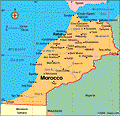
Morocco, about one-tenth larger than California, lies across the Strait
of Gibraltar on the Mediterranean and looks out on the Atlantic from the
northwest shoulder of Africa. Algeria is to the east and Mauritania to the
south. On the Atlantic coast there is a fertile plain. The Mediterranean
coast is mountainous. The Atlas Mountains, running northeastward from the
south to the Algerian frontier, average 11,000 ft (3,353 m) in
elevation.
Government
Constitutional monarchy.
History
Morocco has been the home of the Berbers since the second millennium
B.C. In A.D. 46,
Morocco was annexed by Rome as part of the province of Mauritania until
the Vandals overran this portion of the declining empire in the 5th
century. The Arabs invaded circa 685, bringing Islam. The Berbers joined
them in invading Spain in 711, but then they revolted against the Arabs,
resenting their secondary status. In 1086, Berbers took control of large
areas of Moorish Spain until they were expelled in the 13th century.
The land was rarely unified and was usually ruled by small tribal
states. Conflicts between Berbers and Arabs were chronic. Portugal and
Spain began invading Morocco, which helped to unify the land in defense.
In 1660, Morocco came under the control of the Alawite dynasty. It is a
sherif dynasty—descended from the prophet Muhammad—and rules Morocco to
this day.
During the 17th and 18th centuries, Morocco was one of the Barbary
States, the headquarters of pirates who pillaged Mediterranean traders.
European powers showed interest in colonizing the country beginning in
1840, and there were frequent clashes with the French and Spanish.
Finally, in 1904, France and Spain concluded a secret agreement that
divided Morocco into zones of French and Spanish influence, with France
controlling almost all of Morocco and Spain controlling the small
southwest portion, which became known as Spanish Sahara. Morocco grew into
an even greater object of European rivalry by the turn of the century,
almost leading to a European war in 1905 when Germany attempted to gain a
foothold in the mineral-rich country. By the terms of the Algeciras
Conference (1906), the sultan of Morocco maintained control of his lands
and France's privileges were curtailed. The conference was an indication
of what was to come in World War I, with Germany and Austria-Hungary
lining up on one side of the territorial dispute, and France, Britain, and
the United States on the other.
In 1912, the sultan of Morocco, Moulay Abd al-Hafid, permitted the
French protectorate status. Nationalism expanded during World War II.
Sultan Muhammed V was deposed by the French in 1953 and replaced by his
uncle, but nationalist agitation forced his return in 1955. In 1956,
France and Spain recognized the independence and sovereignty of Morocco.
At his death on Feb. 26, 1961, Muhammed V's son succeeded him as King
Hassan II. In the 1990s, King Hassan promulgated “Hassanian democracy,”
which allowed for significant political freedom while at the same time
retaining ultimate power for the monarch. In Aug. 1999, King Hassan II
died after 38 years on the throne and his son, Prince Sidi Muhammed, was
crowned King Muhammed VI. Since then Muhammed VI has pledged to make the
political system more open, allow freedom of expression, and support
economic reform. He has also advocated giving more rights to women, a
position opposed by Islamic fundamentalists. The entrenched political
elite and the military have also been leery of some reform proposals. With
about 20% of the population living in dire poverty, economic expansion is
a prime goal.
Morocco's occupation of Western Sahara (formerly Spanish Sahara) has
been repeatedly criticized by the international community. In the 1970s,
tens of thousands of Moroccans crossed the border into Spanish Sahara to
back their government's contention that the northern part of the territory
was historically part of Morocco. Spain, which had controlled the
territory since 1912, withdrew in 1976, creating a power vacuum that was
filled by Morocco in the north and Mauritania in the south. When
Mauritania withdrew in Aug. 1979, Morocco overran the remainder of the
territory. A rebel group, the Polisario Front, has fought against Morocco
since 1976 for the independence of Western Sahara on behalf of the
indigenous Saharawis. The Polisario and Morocco agreed in Sept. 1991 to a
UN-negotiated cease-fire, which was contingent on a referendum regarding
independence. For the past decade, however, Morocco has opposed the
referendum. In 2002, King Muhammed VI reasserted that he “will not
renounce an inch of” Western Sahara.
On May 16, 2003, terrorists believed to be associated with al-Qaeda
killed 33 people in several simultaneous attacks. Four bombs targeted
Jewish, Spanish, and Belgian buildings in Casablanca. In the 2004
terrorist bombings in Madrid, Spain, numerous Moroccans were
implicated.
A wave of suicide bombings struck Casablanca in March and April 2007.
Authorities were not certain if the attacks were related
See also Encyclopedia: Morocco. U.S. State Dept. Country Notes:
Morocco
Information Please® Database, © 2007 Pearson Education,
Inc. All rights reserved.
More on Morocco from Infoplease:
- morocco, type of leather - morocco morocco, goatskin leather, dyed on the grain side and boarded by hand or machine to bring ...
- Morocco - Morocco Profile: People, History, Government and Political Conditions, Economy, Foreign Relations, U.S.-Moroccan Relations
- Morocco - Map of Morocco & articles on flags, geography, history, statistics, disasters current events, and international relations.
- French Morocco - French Morocco: French Morocco: see Morocco.
- Spanish Morocco - Spanish Morocco: Spanish Morocco: see Morocco.
|
|