Today's Birthday
Rembrandt1606–69, Dutch painter, etcher, and draftsman, born in Leiden.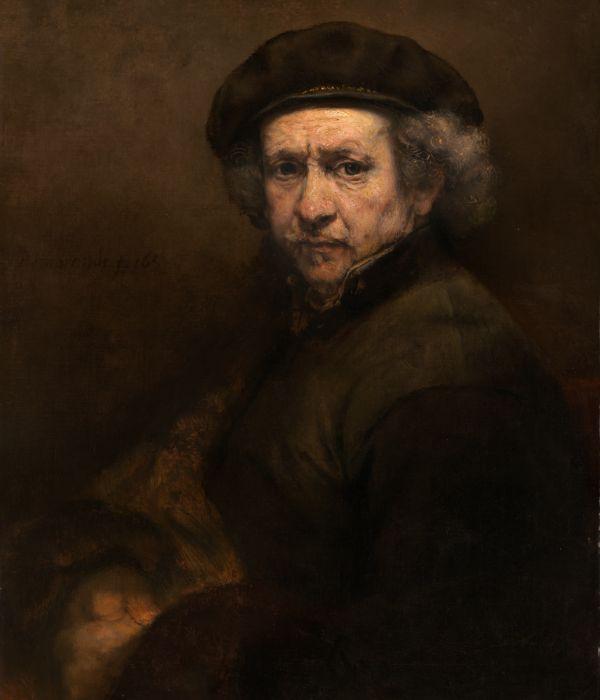

Rembrandt is acknowledged as the greatest master of the Dutch school.
Early Life
A miller's son, Rembrandt attended a Latin school and spent part of one year at the Univ. of Leiden, leaving in 1621 to study painting with a local artist, Jacob van Swanenburgh. His most valuable training was received during the six months of 1624 that he spent in the studio of Pieter Lastman in Amsterdam. Lastman's work affected Rembrandt's in his sense of composition and his frequent choice of religious and historical themes. Receptive to many influences at this time, Rembrandt sometimes reflected the dramatic chiaroscuro of Caravaggio in paintings such as The Money Changer (Berlin) or the more delicate and detailed manner of Elsheimer as in The Tribute Money (London).
The Leiden Years
In 1625 Rembrandt returned to Leiden, where he developed his own distinct style, using the many possibilities of the oil medium, heavily layering the paint, and experimenting with diverse techniques. He showed an unusual preference for the faces of the old and the poor from his earliest works to his latest (e.g., Two Philosophers, Melbourne). In the Leiden years he began the magnificent series of nearly 100 self-portraits that describe the continuing development of his profound self-understanding and self-awareness, as well as his stylistic growth. While in Leiden he collaborated with Jan Lievens and began to teach. He devoted much of his life to teaching, and one of his foremost pupils in Leiden was Gerard Dou.
Amsterdam: Success, Bankruptcy, and a Developing Style
Rembrandt moved to Amsterdam in 1632, where he became established as a portrait painter with his group portrait Anatomy Lesson of Dr. Tulp (1632; The Hague), a traditional subject to which he gave radical treatment. His commissioned portraits include those of Minister Johannes Elison and his wife (Mus. of Fine Arts, Boston) and Nicolas Ruts (Frick Coll., New York City). His position in Amsterdam was further solidified by the dowry and social connections gained by his joyous marriage to Saskia van Ulyenburgh, a burgomaster's daughter.
Affluent and successful, he began to collect numerous works of art, costumes, and curiosities, always learning from the art and often using the costumes in his portraits. During this period his style acquired a new richness of color and greater plasticity of form. He incorporated the vigor, opulence, and drama of the baroque movement, best seen in The Sacrifice of Abraham (St. Petersburg) and The Blinding of Samson (1636, Frankfurt). His studio was filled with pupils, including Jacob Backer, Govaert Flinck, Ferdinand Bol, and later the gifted Carel Fabritius and Nicholas Maes.
Serious financial difficulties began for Rembrandt with his purchase of an impressive house in 1639. Saskia died in 1642 after the birth of their only surviving child, Titus, who was later to become Rembrandt's favorite portrait subject. During the same year he completed his most famous group portrait, The Shooting Company of Capt. Frans Banning Cocq (Rijks Mus.) This work is traditionally called The Night Watch, although a cleaning in 1946–47 revealed a daylight setting. In this work and others instead of painting a conventional group portrait, Rembrandt made of it a crowd spectacle, sacrificing individual identities to dramatic, high-contrast lighting.
During the 1640s Rembrandt developed an enduring interest in landscape. He made numerous etchings, including Three Trees and Christ Healing the Sick, executed with exceptional spontaneity and vigor, and created many works solely for his own pleasure, an unusual practice for his time. This, together with his art collecting, eventually caused financial ruin.
Later Years, Late Masterworks
In 1660 his housekeeper and devoted love for many years, Hendrickje Stoffels, and Titus formed a business partnership to shield the bankrupt Rembrandt from his creditors. In the last two decades of his life Rembrandt, withdrawn from society and no longer fashionable, created many of his masterpieces. These works were more concerned with human character than with outward appearance and are the foundation of his unequaled reputation. Aristotle Contemplating the Bust of Homer (1653; Metropolitan Mus.) reveals his power to elicit a mood of profound mystery and meditation. Among the other remarkable paintings of this period is Bathsheba (Louvre); two of the notable etchings are Three Crosses (1653) and Christ Presented to the People (1655).
The powerful night scene The Conspiracy of the Batavians (1661; Stockholm) is the remaining fragment of his most monumental historical work. To the 1660s belong The Family Group (Brunswick), The Jewish Bride (Rijks Mus.), and The Syndics of the Cloth Guild (1662; Rijks Mus.), all of which are loosely structured, flamelike in color, and psychologically penetrating. Personal tragedy struck the master with the death of Hendrickje in 1663 and of Titus in 1668. Rembrandt lived for one more year, survived by Cornelia, his and Hendrickje's only child.
Achievement
The universal appeal of Rembrandt's art rests upon its profound humanity. His surpassing handling of light was recognized even when his critics considered that his subject matter was vulgar and indecorous. The prodigious output of his lifetime is known to embrace more than 600 paintings, about 300 etchings, and nearly 2,000 drawings. To each medium he gave his best effort.
Outstanding Collections
Rembrandt's work can be found in many European and American museums. The best collections are in Amsterdam, Berlin, The Hague, St. Petersburg, New York City, and Washington, D.C. The Louvre, the British Museum, and the Rijks Museum have good collections of his etchings and drawings. In 1969 five Dutch scholars formed a committee for the study of Rembrandt to reassess the works attributed to the artist.
Bibliography:
Comprehensive editions of his works have been compiled: his paintings by Abraham Bredius (rev. by Hearst Gerson, 3d ed. 1969), his etchings by A. M. Hind (2d ed. 1923, repr. 1967), and his drawings by Otto Benesch (6 vol., 1954–58).
See studies of his life and works by Otto Benesch, Essays on Rembrandt (Vol. I of Benesch's Collected Works, tr. 1970); biography by Ludwig Munz and Bob Haak (1984); study by Oliver Banks (1982).
Who2. Copyright © 1998-2006 by Who2?, LLC. All rights reserved.
Also Born on July 15
- Clement Moorepoet (1779)
- Mother Cabrininun (1850)
- Iris Murdochwriter (1919)
Who Shares Your Birthday?
The Day You Were Born
The Year You Were Born


Trending
Here are the facts and trivia that people are buzzing about.